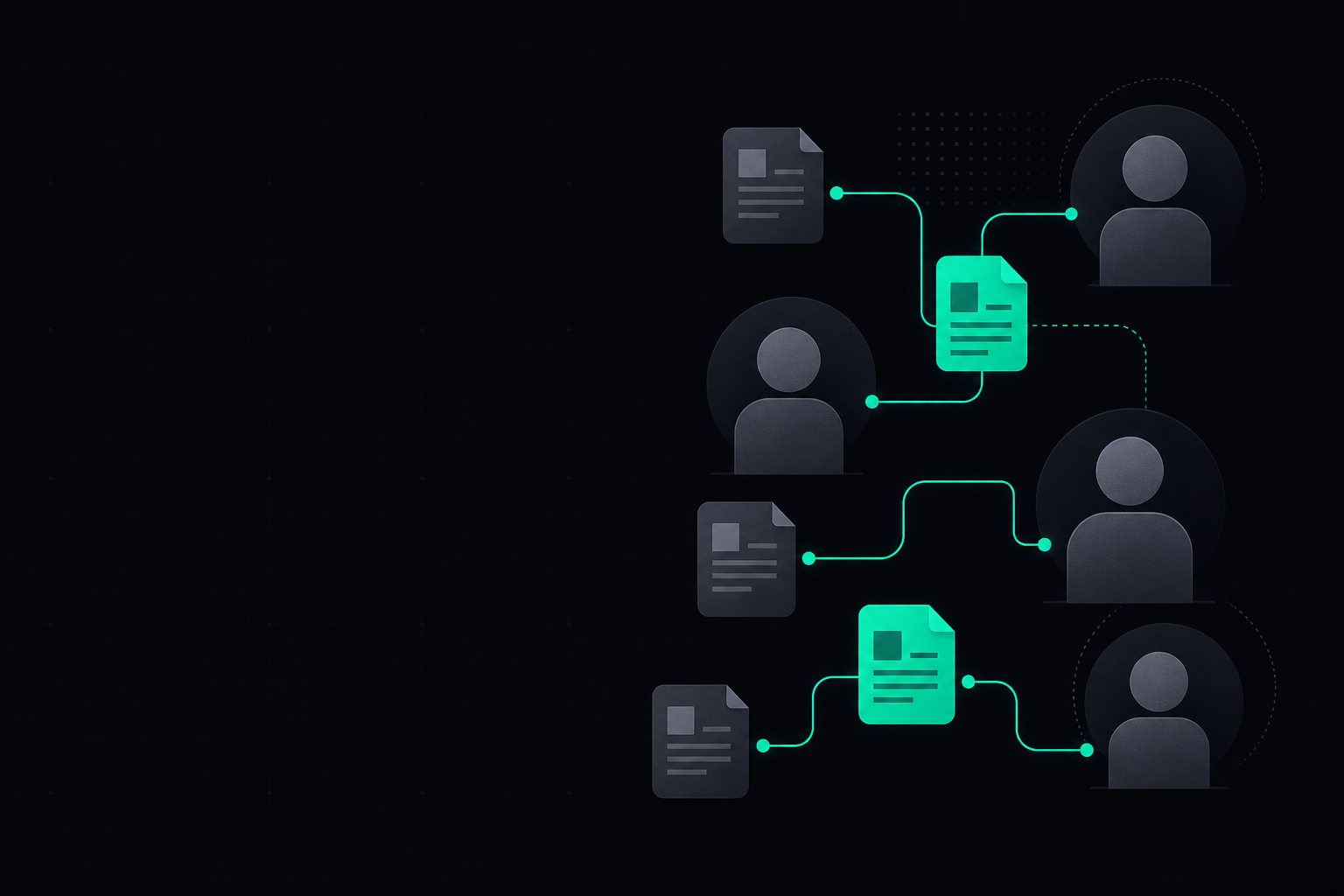
HR and people teams can use AI tools to screen CVs by inputting job descriptions and anonymised CVs, prompting the AI to identify matches in skills, experience, and qualifications. This automates initial filtering, highlighting top candidates and flagging less suitable ones, significantly speeding up the early stages of the recruitment process.
Key takeaways
- AI excels at identifying keyword matches but struggles with nuanced cultural fit.
- Anonymising CVs before AI screening helps mitigate unconscious bias in early stages.
- Always review AI-generated shortlists manually to ensure accuracy and fair assessment.
- Use AI to summarise key candidate strengths and weaknesses against the role, not to make final decisions.
AI-Assisted CV Screening Workflow
This flow outlines how HR teams can integrate AI tools to streamline the initial screening of candidate CVs against a specific job role.
Watch: a 2-minute intro
From the ChatGPT vs Claude vs Gemini vs Perplexity course on AI Bytes Learning.
A worked example
You are an experienced HR professional. Your task is to screen candidate CVs against a specific job description.
The job description is: [PASTE JOB DESCRIPTION HERE].
I will provide you with a candidate's CV.
Your output should be a summary comparing the candidate's suitability against the job description, highlighting key matches and mismatches in skills, experience, and qualifications.
Also, provide a suitability score out of 100.
Candidate CV: [PASTE ANONYMISED CV HERE]
Always verify the AI's assessment against the original CV and job description, especially for nuanced requirements or potential biases.
Which AI Tool for CV Screening Tasks
| Task | Best for | Considerations |
|---|---|---|
| Initial CV Keyword Matching | ChatGPT, Claude, Gemini | Good for high-volume, basic qualification checks. |
| Summarising Candidate Strengths | ChatGPT, Claude | Excellent for quickly extracting key skills and experiences. |
| Identifying Gaps Against JD | Gemini, Perplexity | Can be prompted to specifically highlight missing criteria. |
| Anonymising CVs | Microsoft Copilot (with Word/PDF) | Useful for quick redaction within familiar document tools. |
| Complex Pattern Recognition | NotebookLM (for structured data) | Better for large, structured datasets of past successful hires. |
| Researching Role Requirements | Perplexity | Useful for understanding niche skills or industry terms in a JD. |
Step by step
Here's a step-by-step guide on how HR and people teams can use AI to screen CVs effectively.
- 11. Gather the final job description and all candidate CVs for the role.
- 22. Anonymise candidate CVs by removing names, contact details, and any identifying information to minimise bias.
- 33. Choose an AI tool (e.g., ChatGPT, Claude) and paste the job description into the prompt window.
- 44. Add a clear instruction to the AI to compare a CV against the job description, highlighting matches and gaps.
- 55. Paste each anonymised CV, one by one, into the AI tool as instructed and review the generated assessment.
- 66. Compile a shortlist of candidates based on the AI's assessment and your manual review.
- 77. Conduct a thorough human review of the shortlisted CVs to confirm suitability and consider cultural fit.
What are the limitations of AI in CV screening?
AI is excellent at pattern matching and keyword identification, making it efficient for the initial pass on a large volume of CVs. However, its understanding is purely textual and lacks the nuance of human judgment. AI cannot assess soft skills, cultural fit, or the potential for growth in the same way an experienced recruiter can. It operates on the data it's given, meaning it can miss exceptional candidates who don't perfectly match keywords but possess highly transferable skills or unique experiences. Relying solely on AI for screening risks overlooking valuable talent.
Furthermore, AI models can inadvertently perpetuate biases present in their training data or in the job descriptions themselves. If historical hiring data favoured certain demographics or backgrounds, the AI might learn and replicate those patterns, leading to unfair or discriminatory outcomes. Anonymising CVs before inputting them into AI tools is a crucial step, but human oversight remains essential to ensure fairness and ethical recruitment practices. AI should augment, not replace, human decision-making in HR.
AI excels at identifying keyword matches but struggles with nuanced cultural fit.
How can HR teams prepare data for AI screening?
Preparing your data effectively is paramount for successful AI-assisted CV screening. Start by ensuring your job descriptions are clear, concise, and focused on essential skills and experience, rather than vague aspirations. Ambiguous language can lead to inaccurate AI assessments. Next, standardise your CVs where possible, though this is often difficult with external applicants. The most critical step is anonymisation. Before feeding any CVs into an AI tool, remove all personally identifiable information such as names, addresses, email, phone numbers, and photos.
Tools like Microsoft Copilot, when integrated with Word or PDF editors, can assist with the redaction process, though manual checks are always necessary. The goal is to present the AI with only the relevant professional data: skills, experience, qualifications, and achievements. This minimises the risk of AI inferring demographic information and reduces potential biases. Maintaining a consistent format for the input data, even if it's just plain text, will also help the AI process information more efficiently and accurately.
What's the role of human oversight in AI screening?
Human oversight is not just recommended; it's absolutely essential when using AI for CV screening. AI tools are powerful assistants, but they are not infallible and lack the capacity for true understanding or empathy. HR professionals must act as the ultimate decision-makers, reviewing all AI-generated shortlists and assessments. This involves critically evaluating the AI's reasoning, checking for any missed candidates, or identifying those incorrectly flagged as suitable.
Beyond simply correcting errors, human oversight allows for the assessment of factors AI cannot grasp, such as cultural fit, potential for growth, and nuanced interpretations of experience. It also ensures compliance with anti-discrimination laws and company values. AI Bytes Learning emphasises that AI should free up HR teams from repetitive tasks, allowing them to focus their valuable human insight on the candidates who genuinely warrant deeper consideration, leading to more strategic and ethical hiring decisions.
Frequently asked questions
Can AI tools truly understand the nuances of a candidate's experience?▾
No, AI tools primarily interpret text literally and identify patterns, meaning they struggle with nuanced or implied experiences. They are effective at keyword matching and identifying explicit skills but lack the human ability to infer broader capabilities or potential from less direct descriptions.
Is it possible for AI to introduce bias into the CV screening process?▾
Yes, AI can absolutely introduce or perpetuate bias if its training data or the job descriptions it's given contain historical biases. To mitigate this, it's crucial to anonymise CVs and regularly audit the AI's outputs for fairness and consistency.
Which AI tool is best for screening a very large volume of CVs quickly?▾
For very large volumes and basic keyword matching, general-purpose large language models like ChatGPT, Claude, or Gemini are highly efficient. They can process and compare many CVs against a job description in a short timeframe, providing initial suitability scores or summaries.
Should I use AI to make final hiring decisions based on CV screening?▾
No, AI should never be used to make final hiring decisions. Its role is to assist HR teams by automating initial screening and shortlisting. Final decisions must always involve human review, interviews, and comprehensive assessment to ensure ethical and effective hiring.
How can I ensure candidate privacy when using AI for CV screening?▾
To ensure candidate privacy, always anonymise CVs by removing all personal identifiers before inputting them into any AI tool. Use secure, reputable AI platforms and ensure your data handling practices comply with relevant data protection regulations like GDPR.
Can AI help identify 'hidden gems' whose CVs don't perfectly match keywords?▾
AI is less effective at identifying 'hidden gems' who don't explicitly match keywords, as its strength lies in direct pattern recognition. Human recruiters are better equipped to spot transferable skills or potential that doesn't fit a rigid keyword search.
ChatGPT vs Claude vs Gemini vs Perplexity
ChatGPT, Claude, Gemini, and Perplexity each do different things well. This short course shows you what sets them apart, where each one falls short, and how to pick the right tool for the job — so you stop guessing and start getting better results. [gemma]
Start learningPut this into practice
15 minutes a day. Real AI skills for your job. Free to start.
Get started freeStay Ahead of AI in 15 Minutes a Day
The AI news that actually matters for your work — explained in plain English, with the skill to learn alongside it. Straight to your inbox.
No spam, unsubscribe anytime. We respect your privacy.