AI Redefining Human Cognition
This lesson evaluates how advanced AI models like GPT-4o are reshaping our cognitive processes, from critical thinking to memory retention.
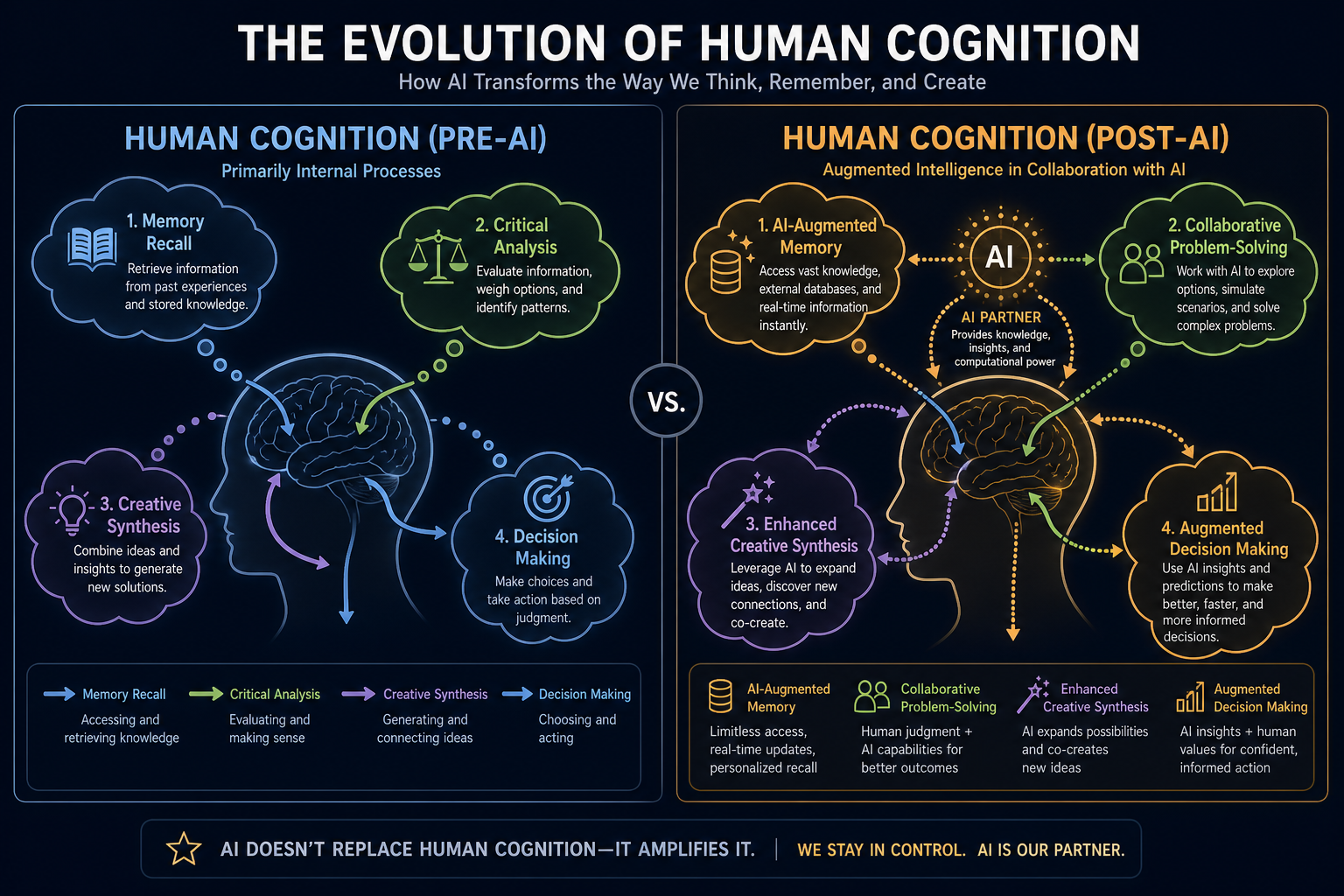
The Cognitive Re-alignment
Advanced AI models, like GPT-4o, do not just process information; they actively engage with our cognitive processes, leading to a re-alignment of how we think and remember. This interaction shifts the burden of rote memorisation and basic information retrieval from human minds to AI, fundamentally altering our mental field.
The mechanism behind this re-alignment involves AI providing instant access to vast knowledge bases and performing complex synthesis tasks that once required significant human effort. Our brains adapt by prioritising higher-order functions such as abstract reasoning, pattern recognition, and creative problem-solving over simple recall. This means we spend less time finding answers and more time interpreting them.
Consider a medical diagnostician using AI: instead of recalling every rare disease symptom, they use AI to cross-reference patient data with global medical literature. The diagnostician's role evolves from encyclopedic recall to critical evaluation of AI-generated probabilities and nuanced patient interaction. This changes the nature of medical expertise.
This cognitive shift has a profound real-world impact, potentially accelerating innovation across all fields by augmenting human intellectual capacity. By offloading cognitive load, we can tackle more complex problems and generate novel solutions, redefining what it means to be intellectually productive in the 21st century.
Our minds are not just changing; they are evolving with AI as a partner.
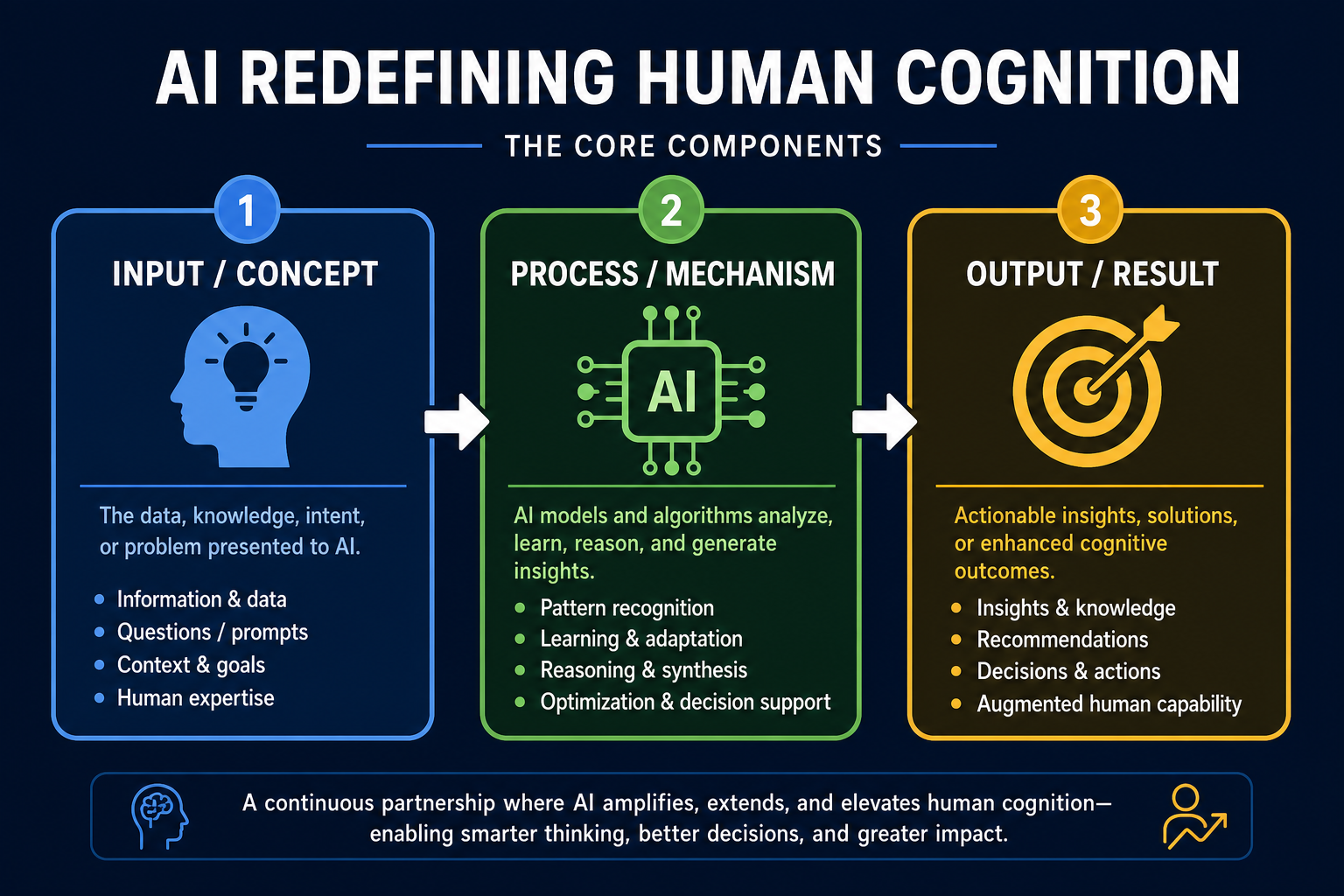
This diagram breaks down the core building blocks of AI Redefining Human Cognition so you can see how each part connects.
Before we begin
Does offloading cognitive tasks to AI make us smarter, or simply more reliant? The immediate answer is neither simple nor singular; it fundamentally reshapes how we define 'smart'.
Which cognitive function is most likely to be enhanced by consistent AI interaction?
This clip shows how AI can act as a effective research assistant, handling information synthesis. It illustrates the shift from rote memorisation to higher-order critical thinking when AI manages data overload.
AI in Research Collaboration
A researcher uses AI to quickly synthesise complex data, freeing up mental capacity for deeper analysis.
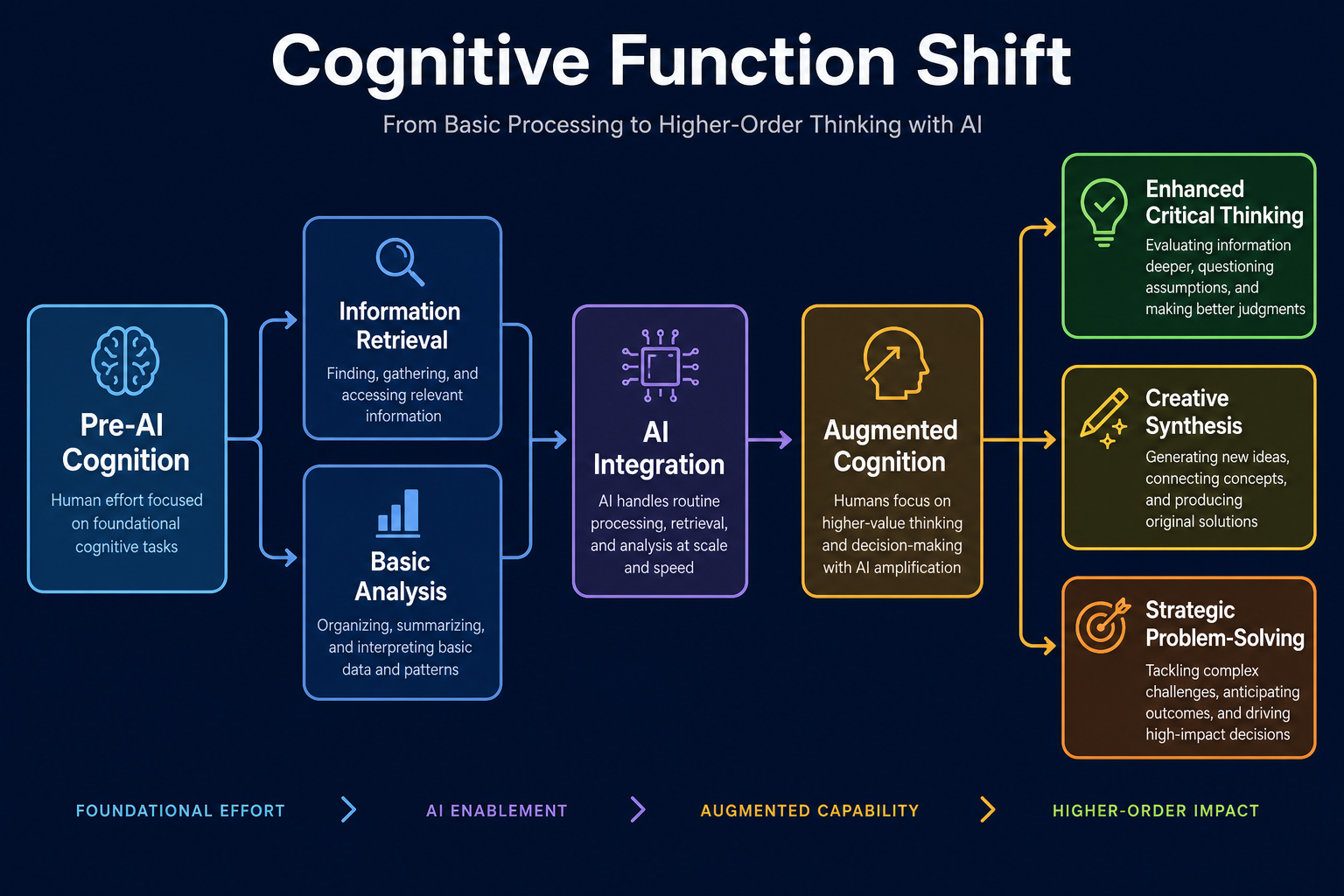
This visual demonstrates how AI integration acts as a catalyst, moving human cognition away from basic information processing towards more sophisticated intellectual activities. The diagram reveals that AI doesn't just add a new tool; it reconfigures the entire cognitive workflow, allowing humans to focus on higher-value tasks. This fundamental re-prioritisation is central to understanding our evolving intelligence.
From Individual Recall to Collaborative Insight
This contrast highlights how AI shifts the locus of critical thinking from a solitary, memory-bound process to a collaborative, data-rich one. The mechanism shown is a cause-effect chain: AI integration directly causes a transformation in how we approach problem-solving, leading to more expansive and efficient outcomes. This fundamentally alters the nature of intellectual work.
Pause and reflect
How do you feel about the idea of AI reshaping your core cognitive abilities?
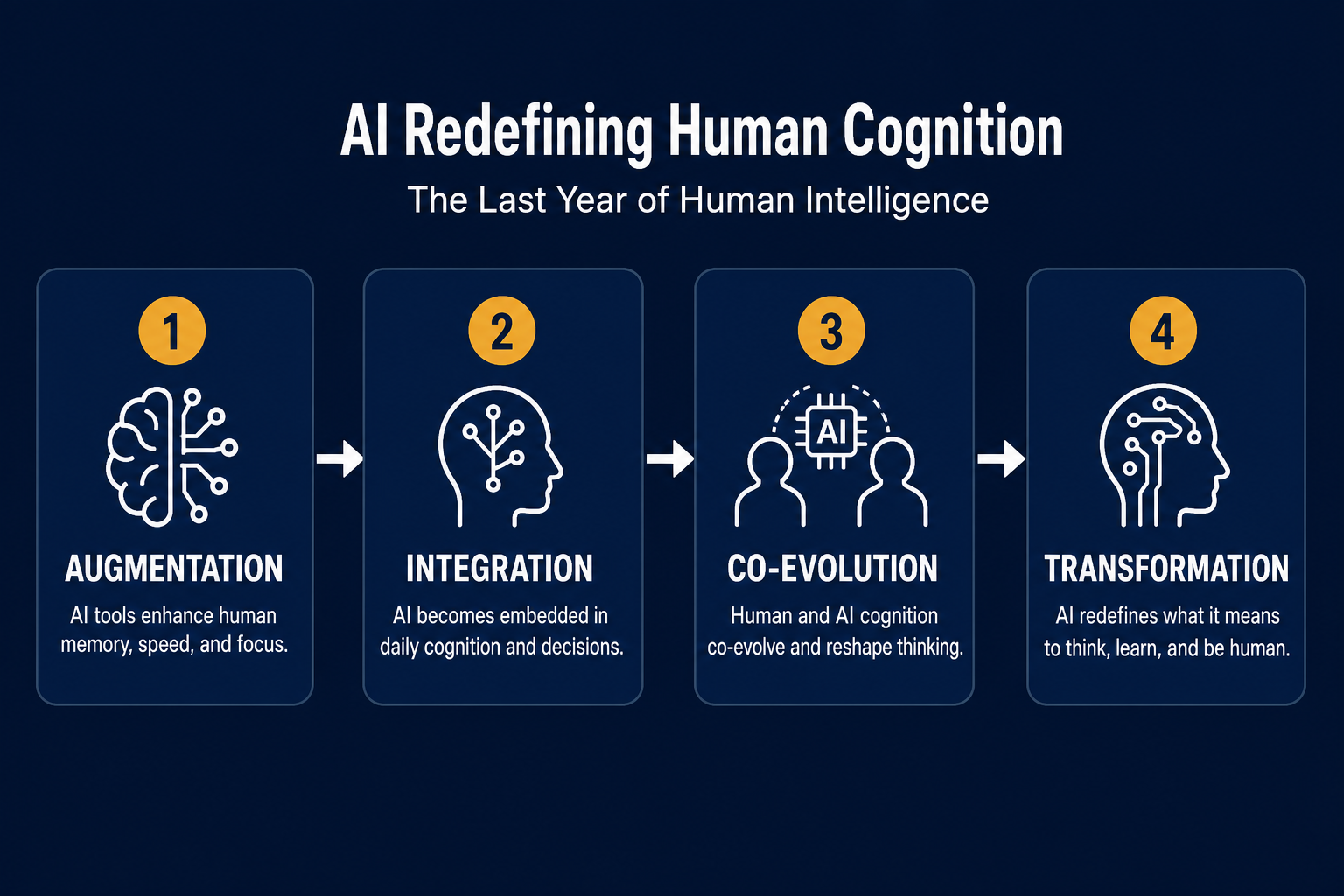
Following the sequence step by step makes AI Redefining Human Cognition straightforward to apply immediately.
AI excels at managing sheer cognitive load, freeing your brain to focus on complex reasoning and problem-solving. This isn't about laziness; it's about strategic allocation of mental resources.
Your creativity isn't replaced, it's amplified. AI can generate a multitude of starting points or divergent ideas, allowing you to refine and connect them in novel ways.
The new critical thinking involves evaluating AI outputs, understanding its limitations, and identifying potential biases. This meta-cognition is a crucial skill for the AI era.
This video shows a team use AI for creative brainstorming, demonstrating how AI can extend human cognitive reach in real-time. It highlights the shift from individual ideation to augmented, collective intelligence.
Collaborative Brainstorming
A design team uses an AI-powered whiteboard to visualise and iterate on complex ideas.
Embracing the Augmented Mind
The shift in human cognition due to AI is not a threat to our intelligence, but an evolution of it. We are moving from a model where human brains were general-purpose processors to one where they are highly specialised, intuitive, and creative directors of advanced AI tools.
This new paradigm requires a conscious effort to adapt our learning and working methodologies.
Understanding this re-alignment allows us to intentionally cultivate skills that complement AI, rather than compete with it. By focusing on critical evaluation, ethical reasoning, and creative synthesis, we can ensure our cognitive abilities remain at the forefront of innovation.
This is how we build a future where human and artificial intelligence thrive together, enhancing our collective potential beyond what either could achieve alone.
If you remember only three things…
Cognitive Load Shifts
AI offloads rote tasks, allowing humans to focus on higher-order thinking like critical evaluation and creative problem-solving. This isn't about replacing; it's about re-prioritising.
Memory Transforms
Memory retention shifts from internal recall to effective externalisation and retrieval via AI. The skill becomes knowing how to ask the right questions, not just knowing the answers.
Critical Thinking Evolves
Critical thinking with AI means evaluating AI-generated insights and biases, rather than solely generating initial hypotheses. This demands new forms of meta-cognition.
Collaboration is Key
The future of human cognition is intrinsically collaborative with AI. Our intelligence becomes augmented, expanding our capacity for innovation and complex decision-making.
Test Your Understanding
Term Glossary
4 verified conceptsThe Augmented Mindset
You now understand that AI doesn't just change tools; it fundamentally reshapes our cognitive architecture, allowing us to engage with problems in entirely new ways. This shift is not about becoming dependent, but about evolving our intellectual capabilities, encourage a new era of collaborative intelligence.
Our minds, augmented by AI, are capable of unprecedented thought and innovation.
The next lesson explores how AI impacts creative processes, moving beyond analysis into generative capabilities.
Audio lesson recap
A concise audio summary of this lesson — great for reinforcing key concepts on the go.
Hear it discussed
About three minutes on the ideas in this lesson
Sterling
AI tutor
Vivienne
Sceptical challenger
Press play to start the discussion…
Full transcript · click any line to jump
Ask anything about AI Redefining Human Cognition. Sterling will answer — concisely, and with his customary level of patience.