Implementing LoRA with Transformers
Learn how to implement LoRA using Hugging Face Transformers. Fine-tune a pre-trained LLM on a text classification task.
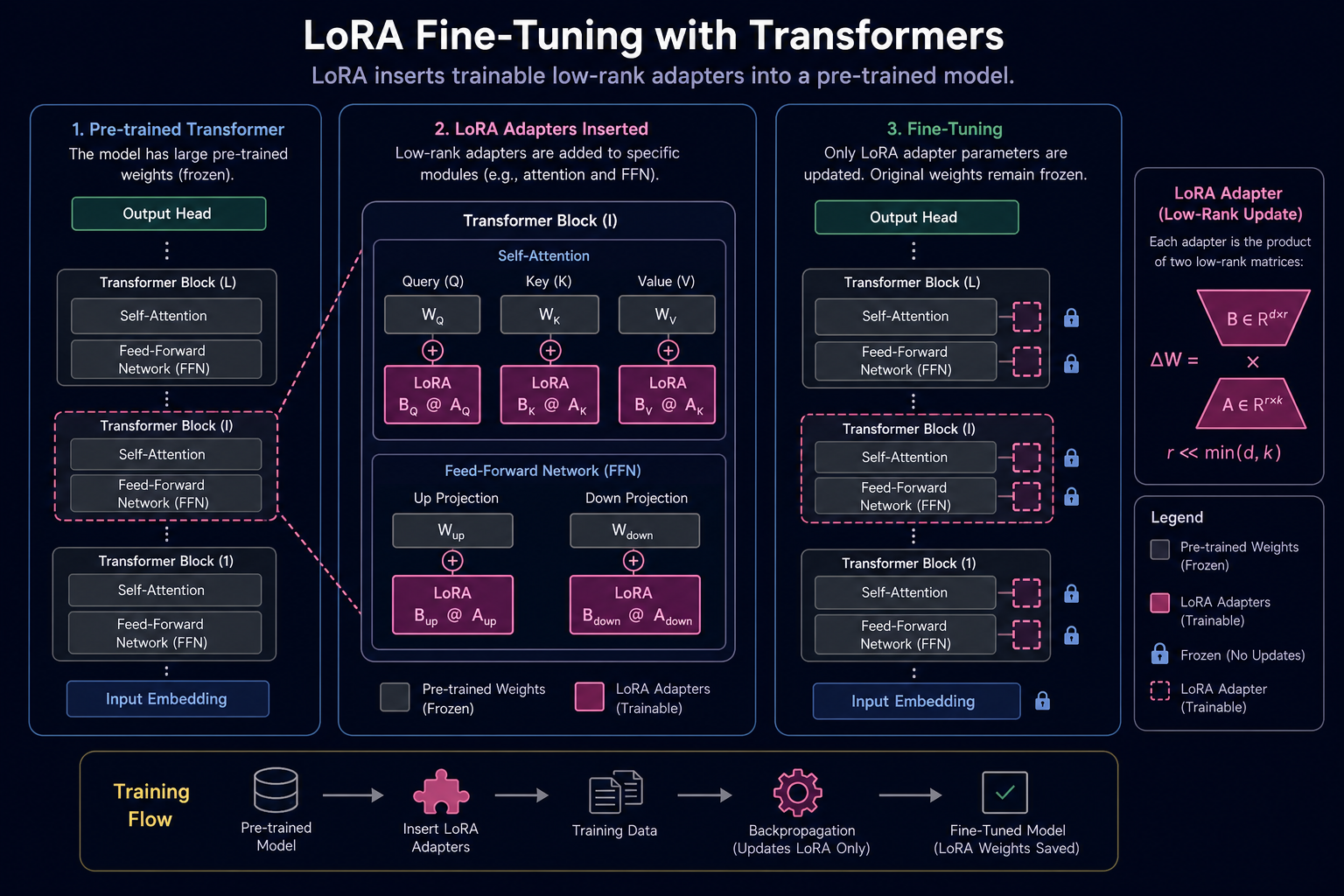
How LoRA Works
fine-tuning technique. It reduces the number of trainable parameters by introducing low-rank fine-tuning, only the adapter weights are updated.">adapters.">LoRA (Low-Rank Adaptation) fine-tunes large language models efficiently. Instead of updating all the model's parameters, it introduces smaller, trainable matrices (fine-tuning, only the adapter weights are updated.">adapters).
These fine-tuning, only the adapter weights are updated.">adapters are added to specific layers of the pre-trained model. During fine-tuning, only the adapter weights are updated, while the original model weights remain frozen.
For example, consider fine-tuning a model for sentiment analysis. fine-tuning technique. It reduces the number of trainable parameters by introducing low-rank fine-tuning, only the adapter weights are updated.">adapters.">LoRA allows us to adapt the model to this specific task by only training a small number of additional parameters, rather than the entire model.
This approach dramatically reduces computational costs and resource requirements. fine-tuning technique. It reduces the number of trainable parameters by introducing low-rank fine-tuning, only the adapter weights are updated.">adapters.">LoRA makes it feasible to fine-tune massive models on consumer-grade hardware, expanding access to custom AI.
LoRA lets you fine-tune massive models on modest hardware – without sacrificing performance.
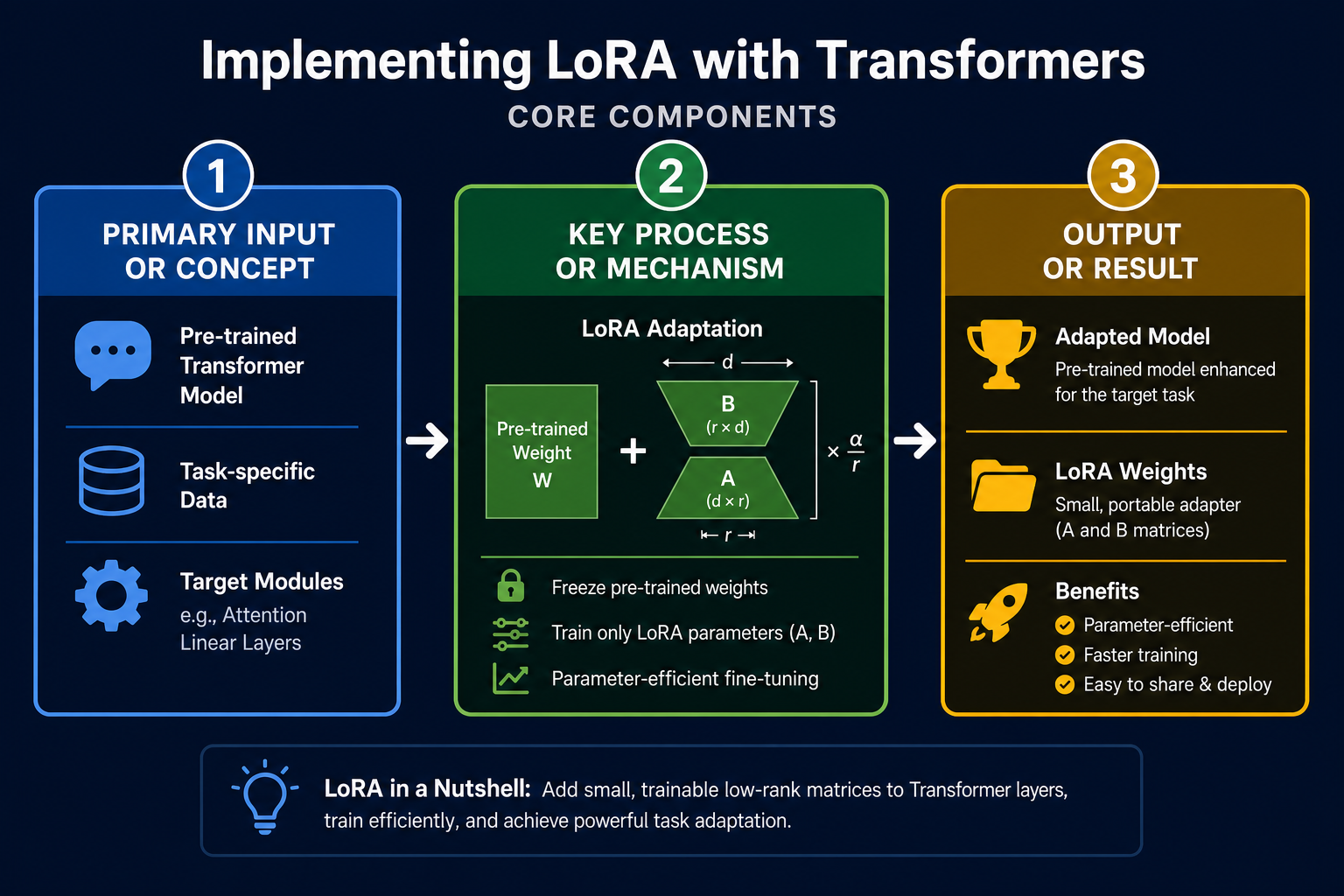
This diagram breaks down the core building blocks of Implementing LoRA with Transformers so you can see how each part connects.
This video shows a data scientist fine-tuning a model using LoRA. This is a practical demonstration of the concepts you will learn in this lesson.
LoRA Fine-Tuning in Action
Visualising LoRA fine-tuning with a data scientist at work.
Which of these is the main advantage of LoRA?
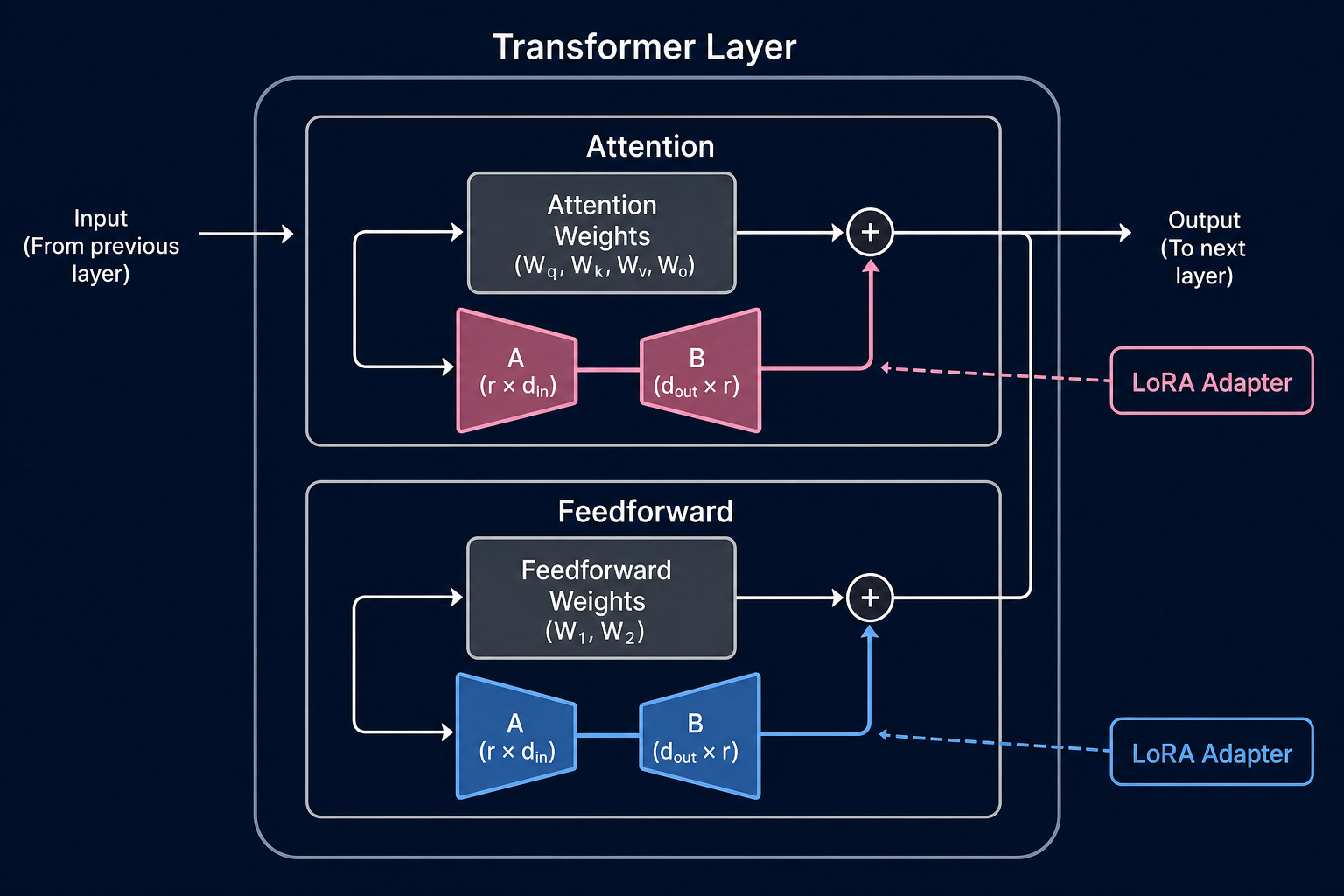
LoRA Adapters
Parameter Efficiency
Traditional fine-tuning updates all of the pre-trained model's weights. This demands significant computational resources and memory.
fine-tuning technique. It reduces the number of trainable parameters by introducing low-rank fine-tuning, only the adapter weights are updated.">adapters.">LoRA addresses this by introducing a low-rank approximation. This reduces the number of trainable parameters by orders of magnitude.
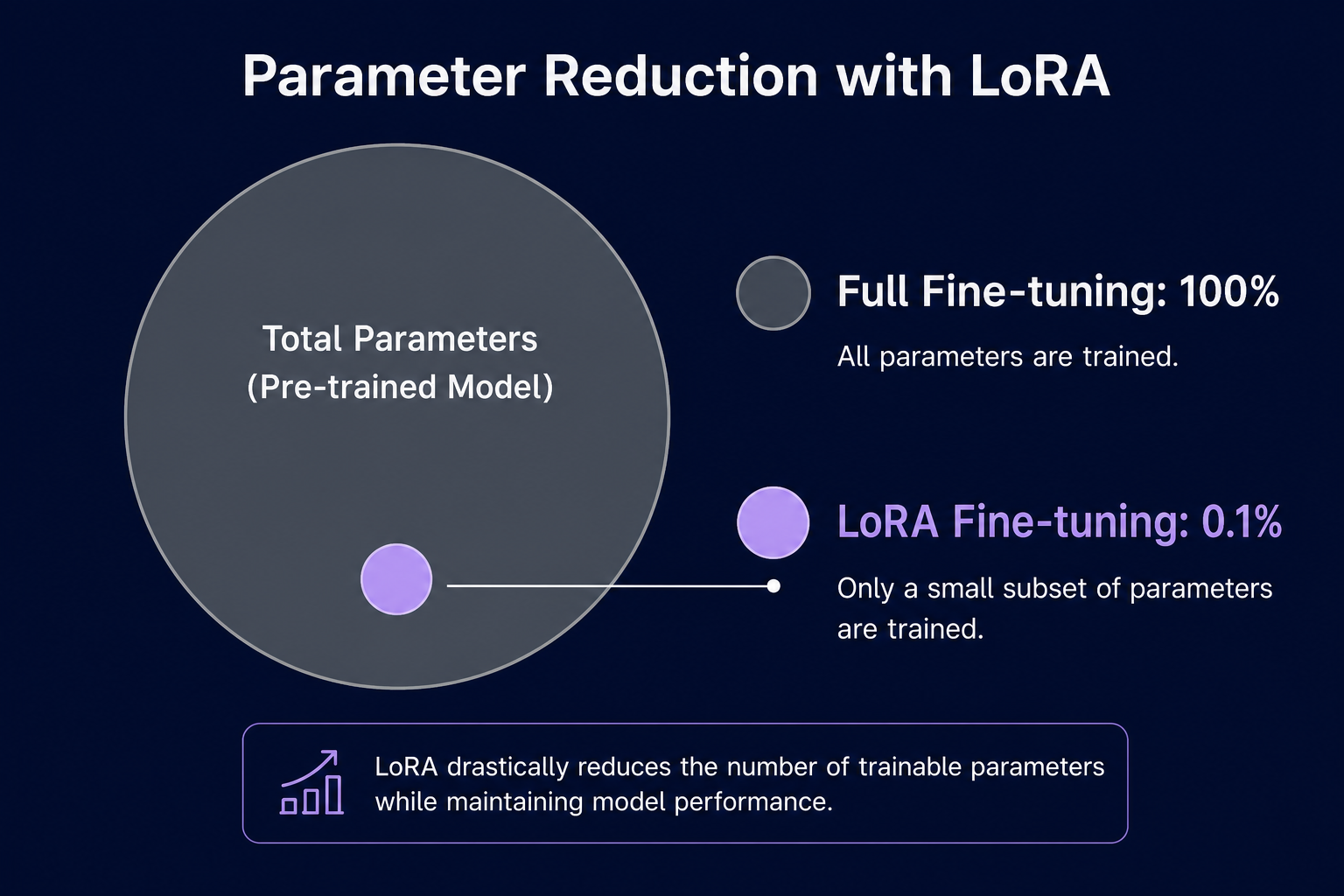
This visual highlights the parameter efficiency of LoRA. By focusing on a small subset of parameters, LoRA makes fine-tuning accessible on limited resources.
Fine-Tuning Contrast
This diagram contrasts the steps involved in full fine-tuning versus LoRA fine-tuning. LoRA reduces the computational cost by only training a small fraction of the parameters.
LoRA is compatible with various Transformer architectures. This makes it a versatile tool for fine-tuning different types of LLMs.
By reducing the number of trainable parameters, LoRA lowers computational costs. This makes fine-tuning more accessible to researchers and practitioners with limited resources.
LoRA accelerates the fine-tuning process. Training only a fraction of the parameters leads to faster convergence and quicker iteration cycles.
This video shows the deployment of a LoRA-tuned model. This demonstrates the real-world application of parameter-efficient fine-tuning.
Deploying a LoRA-Tuned Model
A deployment engineer integrates a LoRA-tuned model into a production system.
LoRA in Practice
fine-tuning technique. It reduces the number of trainable parameters by introducing low-rank fine-tuning, only the adapter weights are updated.">adapters.">LoRA is useful for adapting LLMs to specific tasks while saving on compute. We can now fine-tune models on personal devices.
This technique is transforming how AI models are adapted, opening up new possibilities for customisation. The ability to quickly and cheaply adapt models is enabling new applications.
If you remember only four things…
Parameter Efficiency
LoRA reduces the number of trainable parameters in fine-tuning. This makes it possible to fine-tune large models on limited resources.
Adapter Modules
LoRA inserts small adapter modules into the original model. Only these adapters are trained, leaving the original model weights frozen.
Versatility
LoRA is compatible with various Transformer architectures. This makes it a versatile tool for adapting different types of LLMs.
Lower Cost
Because of the lower resource usage, LoRA reduces the cost of fine-tuning. This makes custom AI more accessible.
Test Your Understanding
Recommend LoRA for Resource-Constrained Fine-Tuning
Based on the scenario, recommend the most suitable fine-tuning strategy for LexiFind AI, justifying your choice by addressing their specific constraints.
A legal tech startup, 'LexiFind AI', aims to specialize an open-source Llama 2 7B model for UK contract analysis. Their engineering team faces significant constraints: a single NVIDIA RTX 3090 GPU and a limited budget. Traditional full fine-tuning is computationally prohibitive. They need a solution that efficiently adapts the large model to their specific dataset, minimizes VRAM usage, reduces training time, and allows for rapid iteration without compromising performance.
Term Glossary
4 verified conceptsEfficient LLM Adaptation
You now understand how to implement LoRA using Hugging Face Transformers. This learn your ability to fine-tune large language models on limited resources, making custom AI more accessible.
LoRA makes custom AI accessible to those with limited computational resources.
Next, we will explore how to use QLoRA to further reduce the memory footprint during fine-tuning, opening up even more possibilities.
Audio lesson recap
A concise audio summary of this lesson — great for reinforcing key concepts on the go.
Hear it discussed
About three minutes on the ideas in this lesson
Sterling
AI tutor
Vivienne
Sceptical challenger
Press play to start the discussion…
Full transcript · click any line to jump
Fine-tune LLMs with limited resources
LoRA enables you to adapt large language models to specific tasks even with modest computational hardware. This dramatically reduces the cost and resource requirements for custom AI applications.
LoRA updates only small adapters
Instead of training all model parameters, LoRA introduces small, trainable matrices (adapters) into specific layers. Only these adapter weights are updated, leaving the original model frozen.
Accelerate fine-tuning and reduce costs
By training only a fraction of the parameters, LoRA speeds up the fine-tuning process, leading to faster iteration cycles. This makes custom AI more accessible and cost-effective for researchers and practitioners.
Ask anything about Implementing LoRA with Transformers. Sterling will answer — concisely, and with his customary level of patience.