Orchestrating Autonomous Discovery
Learn to configure an orchestration layer that transforms agent discovery history into a reusable replay simulator.
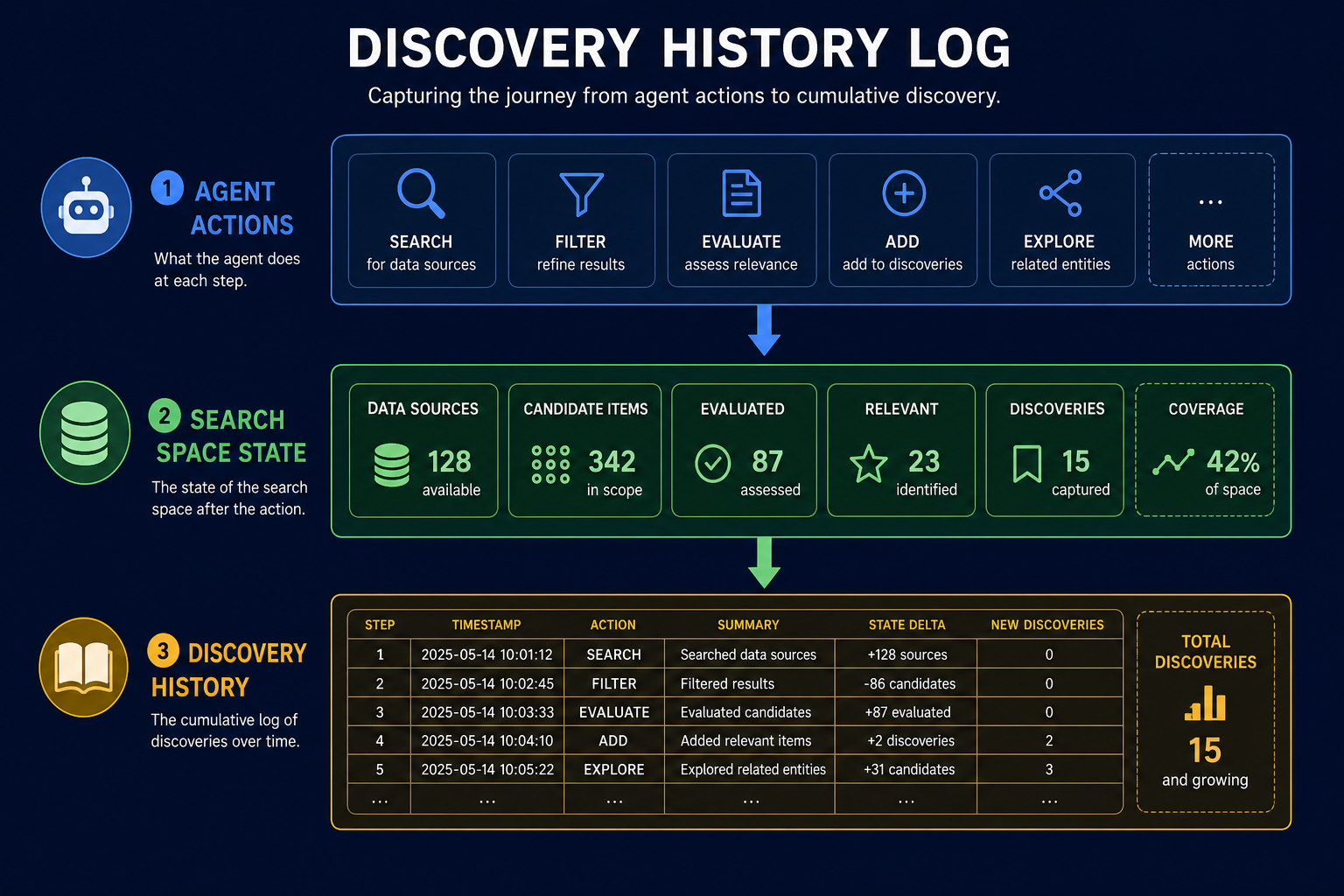
The Discovery Bottleneck
Autonomous agents often treat each exploration attempt as a fresh start. This ignores the vast amount of knowledge generated during previous proposal cycles.
An orchestration layer captures these past actions into a structured replay simulator.">discovery history. This history acts as a replay simulator for future policy refinement.
Orchestrating Discovery
Complete the logic for your discovery logger. Identify the key data points required to turn a raw action into a replayable simulator step.
Your agent is currently proposing code snippets for a GPU kernel. Currently, these are run once and deleted. You need to log the 'proposed_code', 'execution_time', and 'binary_output' into a JSON structure that can be indexed by the simulator.
Before we begin
Why does your agent keep making the same exploration mistakes despite having seen the solution before? The answer lies in the absence of a structured orchestration layer to log and replay discovery history.
What is the primary role of the orchestration layer in the Dream-RSI framework?
Building the Simulator
You create the simulator by mapping agent actions to successful outcomes found in the logs. This enables the agent to evaluate new ideas against historical data.
This process reduces the need for expensive online evaluations by providing immediate off-policy feedback. You get more discovery for less computational cost.
Discovery history is not just a log, it is a simulator for future intelligence.
Exploration Paradigms
The contrast shows the shift from discarding data to use it for policy refinement. The orchestration layer creates a feedback loop that lowers cost while increasing discovery quality.
Treat every failed exploration as a data point that improves your simulator's accuracy.
Recursive improvement depends on the speed of your off-policy feedback mechanism.
Programmable orchestration makes your exploration strategy transparent and easier to debug.
The viewer observes the real-time logging and simulation process. This demonstrates how the orchestration layer creates the replay simulator for the agent.
Configuring the Orchestrator
Observing the orchestration layer in action during a simulation run.
Test Your Understanding
If you remember only three things…
Persistent Memory
Discovery history must be logged to prevent repeating past exploration mistakes.
Simulator Construction
Historical logs serve as a replay simulator for evaluating new policy proposals.
Feedback Efficiency
Off-policy feedback allows for rapid refinement without expensive online evaluations.
Orchestration Power
Programmable orchestration layers turn agents into recursive self-improving systems.
Term Glossary
4 verified conceptsFrom Blind Search to Informed Discovery
You now understand how to turn transient agent outputs into a persistent discovery simulator. This shift moves your agents from reactive exploration to recursive self-improvement.
This is where autonomous agents stop guessing and start learning from their own history.
In the next lesson, we will cover implementing the policy optimization loop using the simulator.
Audio lesson recap
A concise audio summary of this lesson — great for reinforcing key concepts on the go.
Hear it discussed
About three minutes on the ideas in this lesson
Sterling
AI tutor
Vivienne
Sceptical challenger
Press play to start the discussion…
Full transcript · click any line to jump
Ask anything about Orchestrating Autonomous Discovery. Sterling will answer — concisely, and with his customary level of patience.