Challenges in Text Processing
Explore why tokenizing text for large language models is more complex than simply splitting sentences into words.
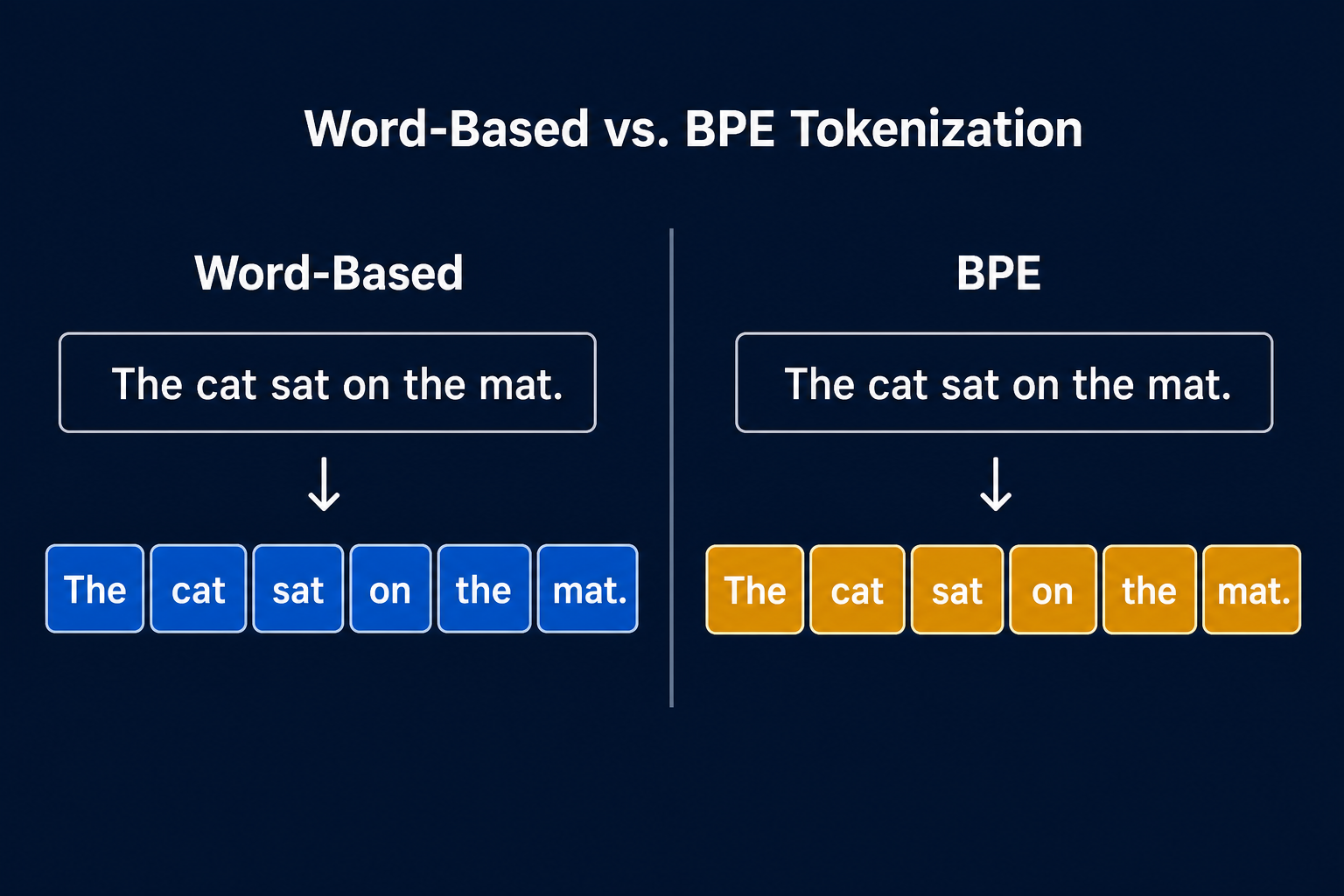
Limitations of Naive Tokenization
Why is simple word-based tokenization often insufficient for LLMs? It struggles with the vastness and diversity of language.
Consider variations in word forms, typos, and the presence of out-of-vocabulary (OOV) words, and languages without explicit word boundaries. These challenges make creating a complete dictionary of all possible words nearly impossible, hindering an LLM's ability to generalize and understand new text.
Tokenization isn't just splitting text; it's a fundamental choice affecting model performance.
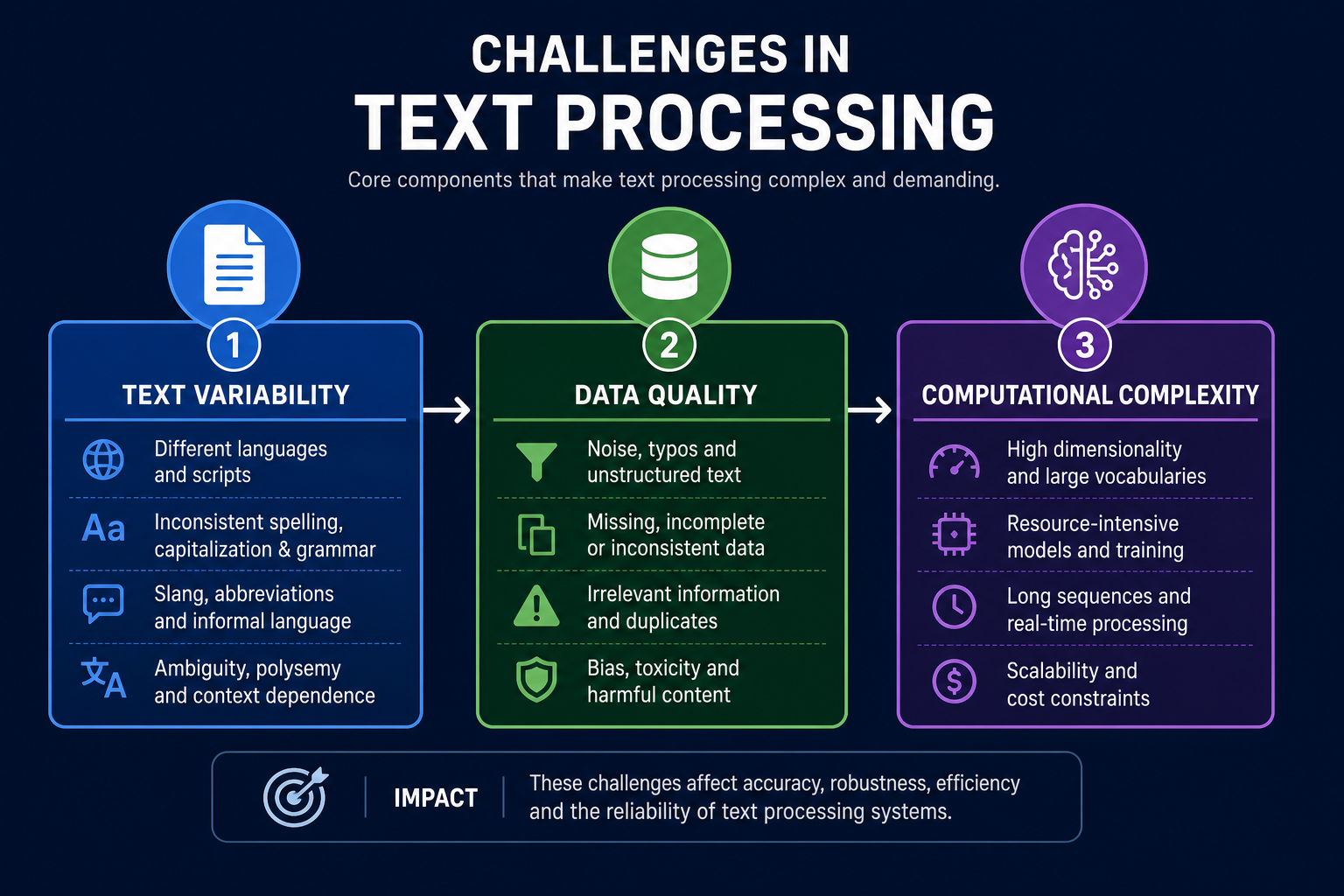
Visual illustration of Challenges in Text Processing.
You'll see a developer working with tokenization code. This helps illustrate the practical side of the concepts we're covering.
Tokenization in Practice
See tokenization at work.
Which of these options is NOT a challenge when using word-based tokenization for LLMs?
Word-Based vs. BPE
Character-by-Character Tokenization
What about tokenizing text character by character? It's a feasible approach but introduces new challenges.
While it avoids the OOV problem, it results in extremely long sequences. This dramatically increases computational complexity, especially for transformer models where complexity grows quadratically with sequence length.
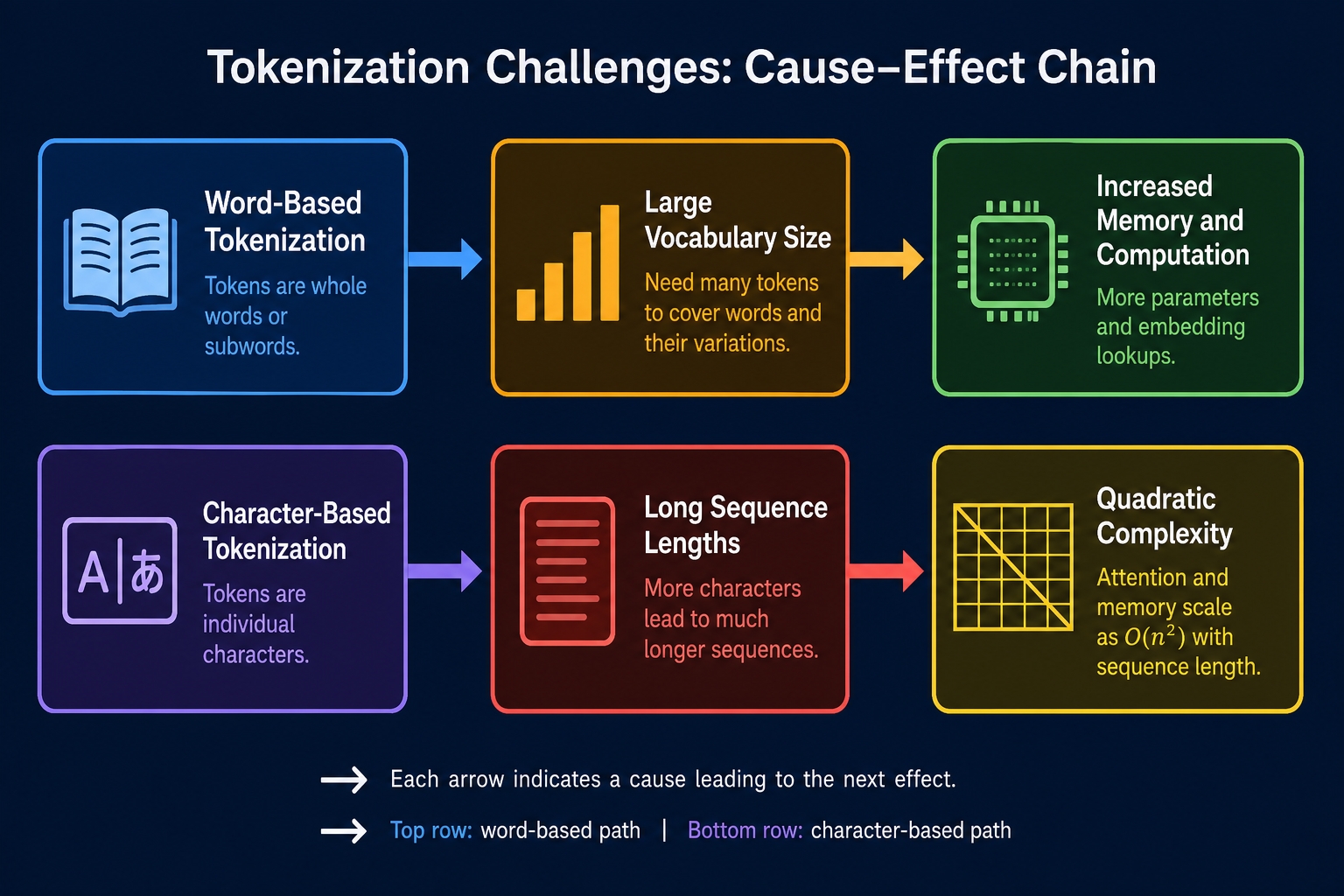
This diagram illustrates the challenges of both word-based and character-based tokenization. It shows how each approach leads to distinct computational bottlenecks, requiring more sophisticated methods.
Tokenization Strategies
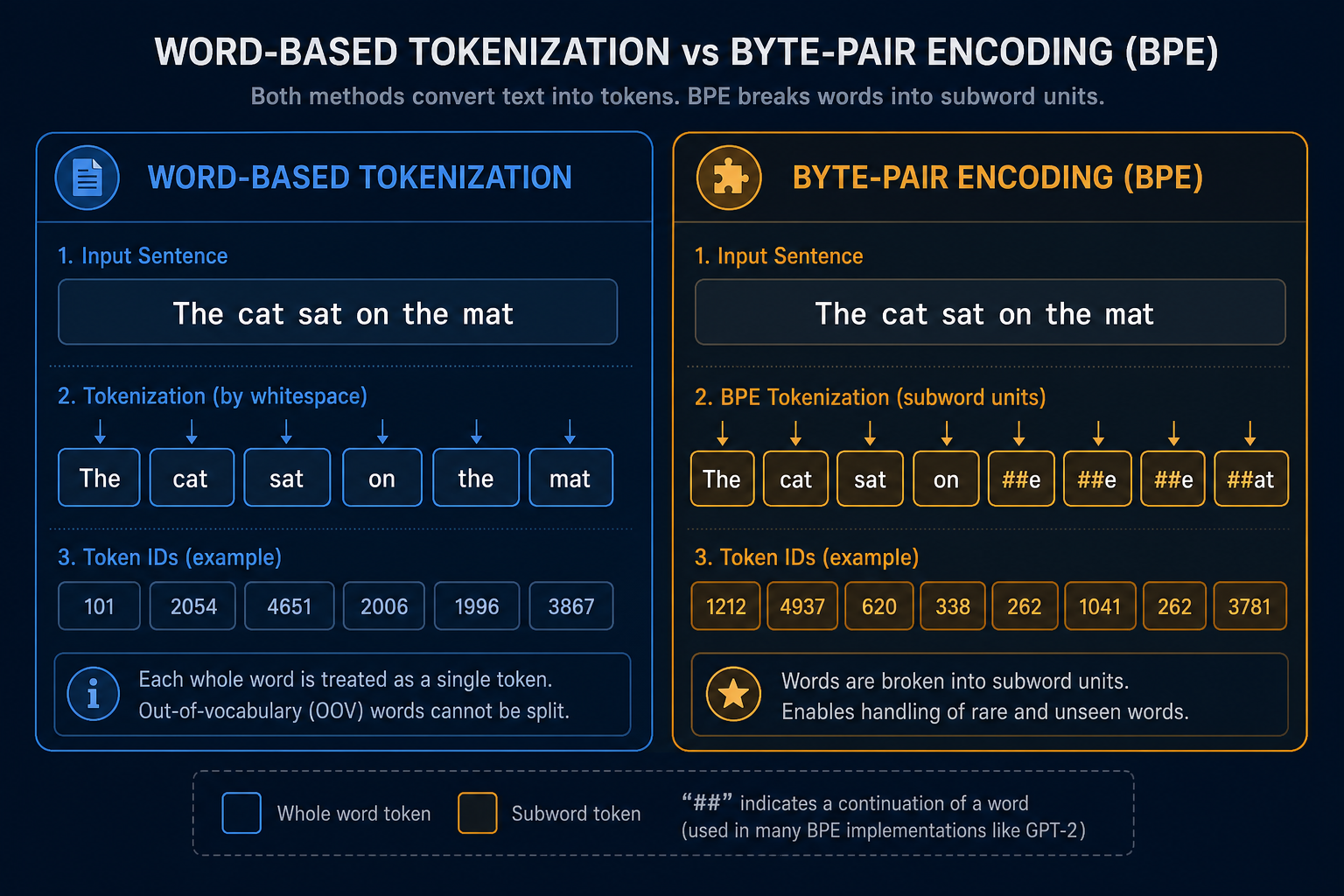
This diagram contrasts word-based tokenization with BPE. BPE addresses the OOV problem by creating a vocabulary of subword units, enabling the model to handle unseen words more effectively.
Out-of-vocabulary words are a major challenge for word-based tokenizers. BPE addresses this by breaking words into smaller, more manageable units.
Character-based tokenization can lead to very long sequences. This increases computational complexity, especially in transformer models.
Choosing a tokenizer involves balancing vocabulary size and sequence length. BPE offers a good compromise between these two factors.
You'll see how different code elements are tokenized. This highlights the impact of tokenization on model understanding and generation.
Tokenizing Code
See how code tokenization impacts model performance.
Moving Beyond Word-Based Methods
We've seen how naive word-based tokenization struggles with LLMs. The core issue is its inability to handle the complexity and variability of natural language.
More advanced techniques, like BPE, address these limitations by breaking words into subword units. This allows for a smaller vocabulary and better handling of unseen words, improving overall model performance.
If you remember only four things…
Word-Based Tokenization
Splitting text into individual words is simple but struggles with variations and out-of-vocabulary words. This limits an LLM's ability to generalize.
Character-Based Tokenization
Tokenizing character by character avoids OOV issues but leads to very long sequences. The computational cost then becomes prohibitively high.
Byte-Pair Encoding (BPE)
BPE balances vocabulary size and sequence length by merging frequent character pairs into tokens. This improves handling of unseen words.
Trade-offs
Choosing a tokenization method involves weighing the trade-offs between vocabulary size, sequence length, and computational complexity. BPE offers a useful compromise.
Test Your Understanding
Improve Tokenization in a Prompt
Write a prompt that instructs an AI to correctly tokenize a challenging piece of text, ensuring common tokenization pitfalls are avoided.
Default tokenizers often struggle with specific linguistic features like hyphenated terms, contractions, or domain-specific jargon, leading to fragmented tokens. For instance, consider this sentence from a medical report: 'The patient's post-operative recovery was AI-driven, incorporating real-time bio-feedback data. He hadn't experienced such rapid re-integration before.' A basic tokenizer might incorrectly split 'post-operative', 'AI-driven', 'bio-feedback', 'hadn't', or 're-integration'. Your task is to write a prompt that guides the AI for more accurate tokenization of this text.
Term Glossary
4 verified conceptsBeyond Simple Word Splitting
You now understand why straightforward word-based tokenization isn't sufficient for large language models. You've seen the trade-offs involved in different approaches, especially the balance BPE strikes.
Effective tokenization is about balancing vocabulary size and computational efficiency.
Next, we'll explore the mechanics of Byte-Pair Encoding in more detail, examining how it merges frequent character pairs and builds its vocabulary.
Audio lesson recap
A concise audio summary of this lesson — great for reinforcing key concepts on the go.
Hear it discussed
About three minutes on the ideas in this lesson
Sterling
AI tutor
Vivienne
Sceptical challenger
Press play to start the discussion…
Full transcript · click any line to jump
Simple tokenization limits LLM understanding
Word-based tokenization struggles with language diversity, out-of-vocabulary words, and variations, hindering an LLM's ability to generalise. This fundamental limitation directly impacts how effectively large language models can process and comprehend text.
Character tokenization creates computational bottlenecks
While character-based tokenization avoids out-of-vocabulary issues, it generates extremely long sequences. This dramatically increases computational complexity, particularly for transformer models where complexity grows quadratically.
BPE balances vocabulary and sequence length
Byte-Pair Encoding (BPE) offers a practical compromise by breaking words into subword units, reducing vocabulary size and improving handling of unseen words. This technique addresses the limitations of both simple word and character-based methods.
Ask anything about Challenges in Text Processing. Sterling will answer — concisely, and with his customary level of patience.