Structuring Effective Prompts
Master the art of building precise prompts that force Claude to deliver the exact output you need.
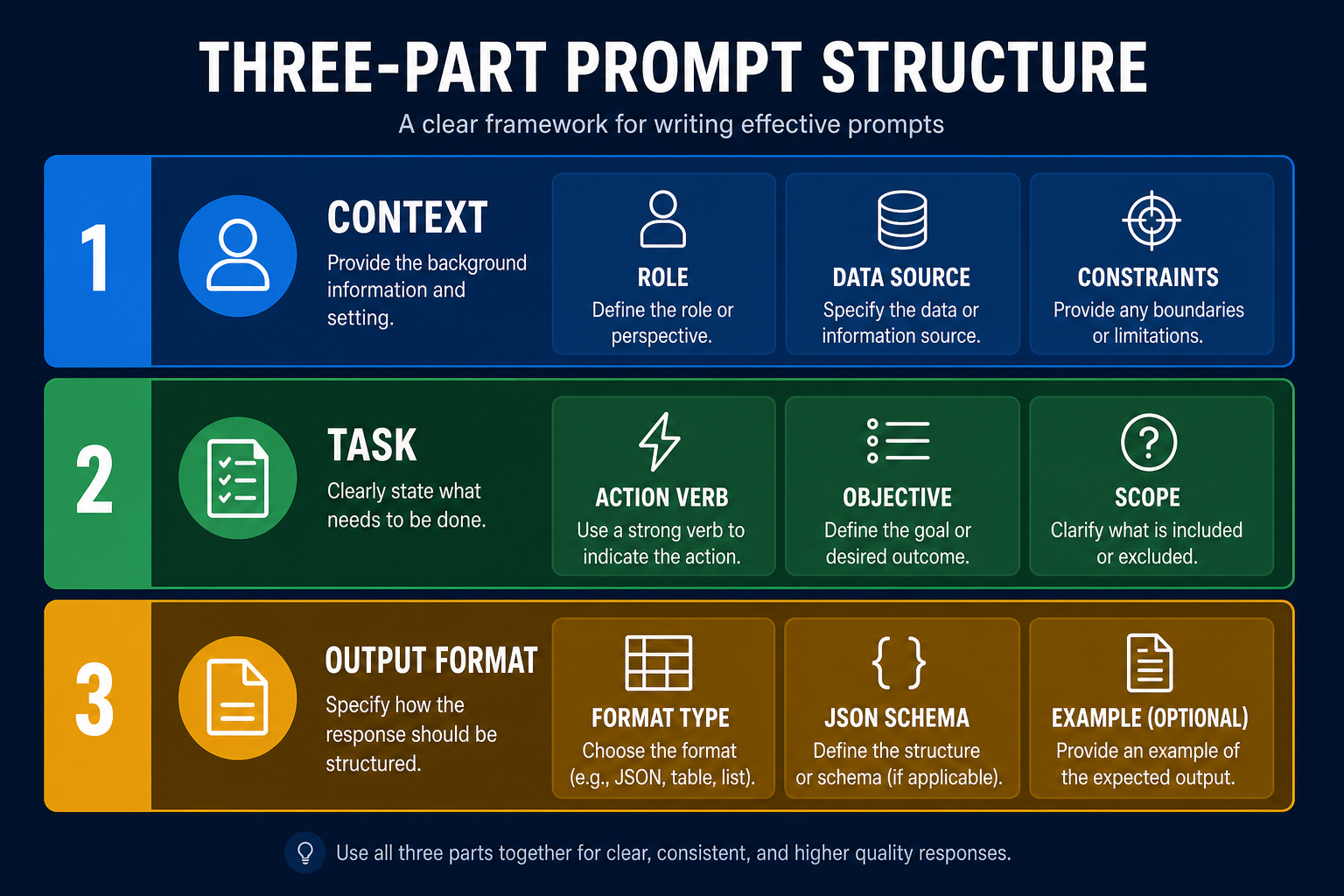
The Three Pillars of Prompting
Effective prompting relies on the separation of three distinct elements: context, task, and format. By isolating these, you ensure the model understands the environment, the action, and the final shape of the answer.
When you mix these elements into a single stream of text, the model loses clarity on what matters most. Explicitly labelling these sections prevents the model from hallucinating requirements or ignoring constraints.
Fix the Ambiguous Prompt
Rewrite the following vague request into a structured prompt using Context, Task, and Format.
Prompt: 'Tell me about the logs for the server, I need to know why it crashed.'
Before we begin
Why does your prompt produce a rambling summary when you need a clean data table? The issue lies in the missing structural constraints, not in Claude's ability to process your request.
Which of these components is most critical for ensuring Claude outputs a CSV file instead of a paragraph?
Framing the Request
Implementing Contextual Anchors
Context acts as the foundation for your prompt, providing the necessary constraints or background data for the task. Without it, the model operates in a vacuum and often defaults to generic knowledge.
You can anchor the model by defining a role, such as 'You are a senior data engineer'. This simple framing shifts the probability distribution of the model's vocabulary toward technical accuracy.
Cause-Effect Chain in Prompting
This diagram reveals how structure directly reduces the path to a usable result. The contrast shows that while the model works in both cases, structured prompts remove the cognitive load of guessing your intent.
The viewer sees an engineer transforming a messy request into a structured prompt. This matters because it highlights the transition from natural language to precise, machine-readable instructions.
Refining the Workflow
Observing the shift from raw text to structured prompt inputs.
Context does not just add detail; it removes incorrect possibilities by defining the boundaries of the task.
Always define the output structure last to ensure the model adheres to your schema.
If the output is wrong, keep the context and format, but rewrite the task verb to be more specific.
Structuring your prompt by isolating context, task, and format turns ambiguous requests into reliable, machine-readable output.
Clear boundaries prevent the model from drifting into generic explanations.
Test Your Understanding
If you remember only three things…
Separate concerns
Keep context, task, and format distinct to avoid model confusion.
Use role-based framing
Defining a persona shifts the model's focus to relevant expertise.
Format at the end
Positioning structure requirements last ensures they govern the final output.
Iterate the verb
If results are poor, sharpen your action verb before changing the context.
Term Glossary
4 verified conceptsFrom Ambiguity to Precision
You now view prompts as structured inputs that define the boundaries of model reasoning, moving beyond casual requests to reliable technical interaction.
Structure is the bridge between a vague request and a precise, usable result.
In the next lesson, we will examine iterative refinement to handle complex multi-step workflows.
Audio lesson recap
A concise audio summary of this lesson — great for reinforcing key concepts on the go.
Hear it discussed
About three minutes on the ideas in this lesson
Sterling
AI tutor
Vivienne
Sceptical challenger
Press play to start the discussion…
Full transcript · click any line to jump
Ask anything about Structuring Effective Prompts. Sterling will answer — concisely, and with his customary level of patience.