What are AI Agents?
This lesson defines AI agents and distinguishes them from simple LLM applications. You will understand their core characteristics and how they operate autonomously.
Defining an AI Agent
An AI agent is a software entity capable of perceiving its environment, making decisions, and taking actions to achieve specific goals. Unlike a simple Large Language Model (LLM), an agent operates with a degree of autonomy and purpose. This autonomy allows agents to manage complex, multi-step processes without continuous human intervention.
The core mechanism of an agent involves a continuous loop of observation, planning, action, and reflection. It does not merely respond to a single prompt; instead, it maintains state, remembers past interactions, and adapts its strategy. This iterative process allows agents to work through dynamic environments effectively.
Consider an agent designed to book a flight: it would first observe available flights, plan a route based on user preferences, take actions like searching different airlines, and then reflect on whether the chosen flight meets all criteria. This contrasts sharply with an LLM that might just generate a list of flights. The agent actively pursues the goal.
This agentic capability has a profound real-world impact, enabling automation for tasks that previously required human judgment and sequential execution. From automating customer service to managing complex IT operations, agents extend AI's utility beyond content generation. They transform passive AI tools into active problem-solvers.
Agents automate decisions; LLMs generate text. This difference is fundamental.
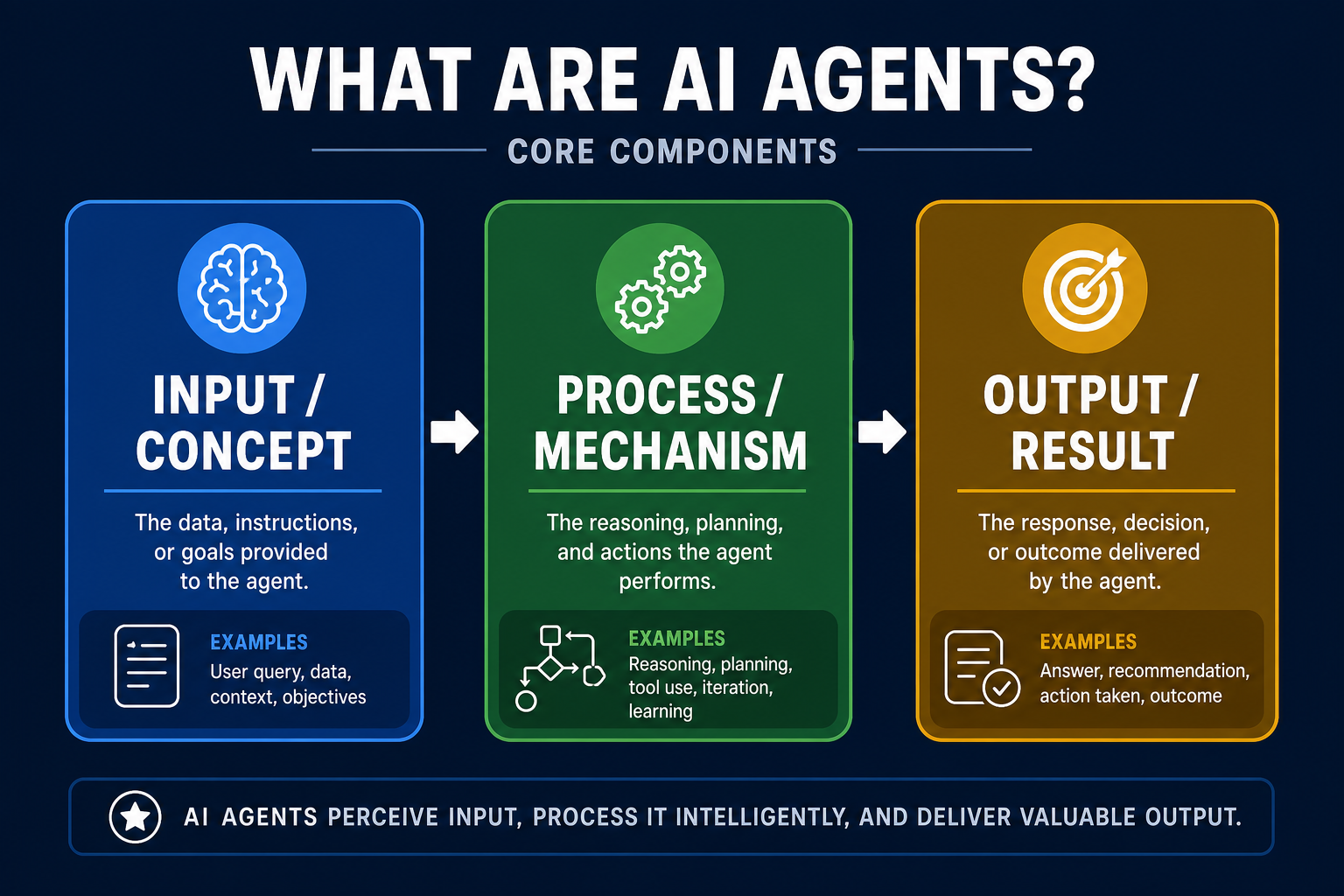
This diagram breaks down the core building blocks of What are AI Agents? so you can see how each part connects.
This video shows an AI agent system autonomously processing a task, visualising its internal decision-making. It matters because it illustrates the agent's independence in executing complex workflows.
Agentic Workflow in Action
Observe an AI agent autonomously executing a task.
Before we begin
Why does a simple prompt to an LLM often require constant human refinement? The answer lies in the LLM's design; it is a sophisticated text predictor, not a decision-maker.
Which characteristic most distinguishes an AI agent from a standalone Large Language Model (LLM)?
The Dawn of Autonomous Systems
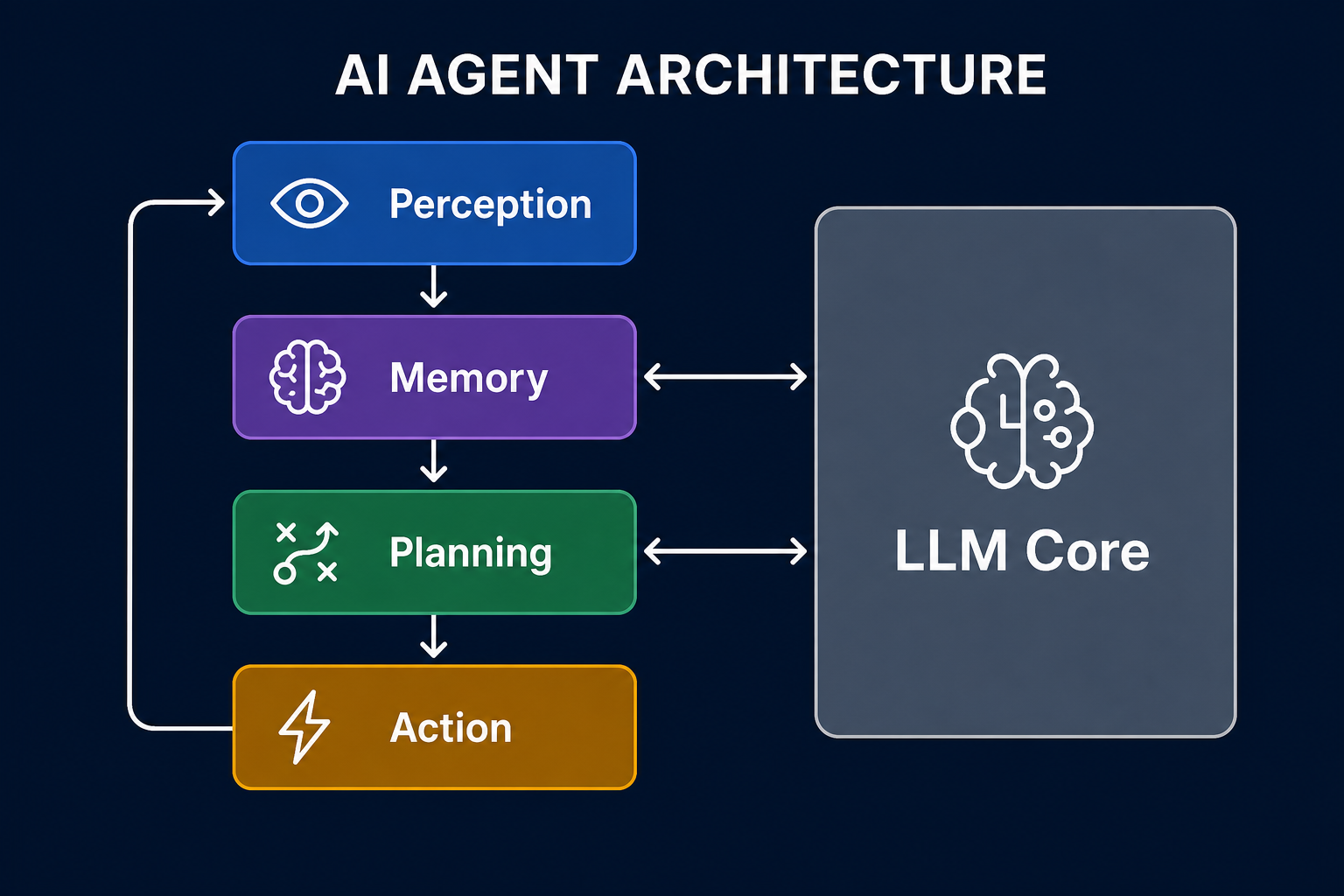
Components of an AI Agent
From LLM to Agent
A Large Language Model (LLM) excels at understanding and generating human-like text based on its training data. It processes an input prompt and produces a single output, completing a given task within that one interaction. Its strength lies in language fluency and contextual understanding.
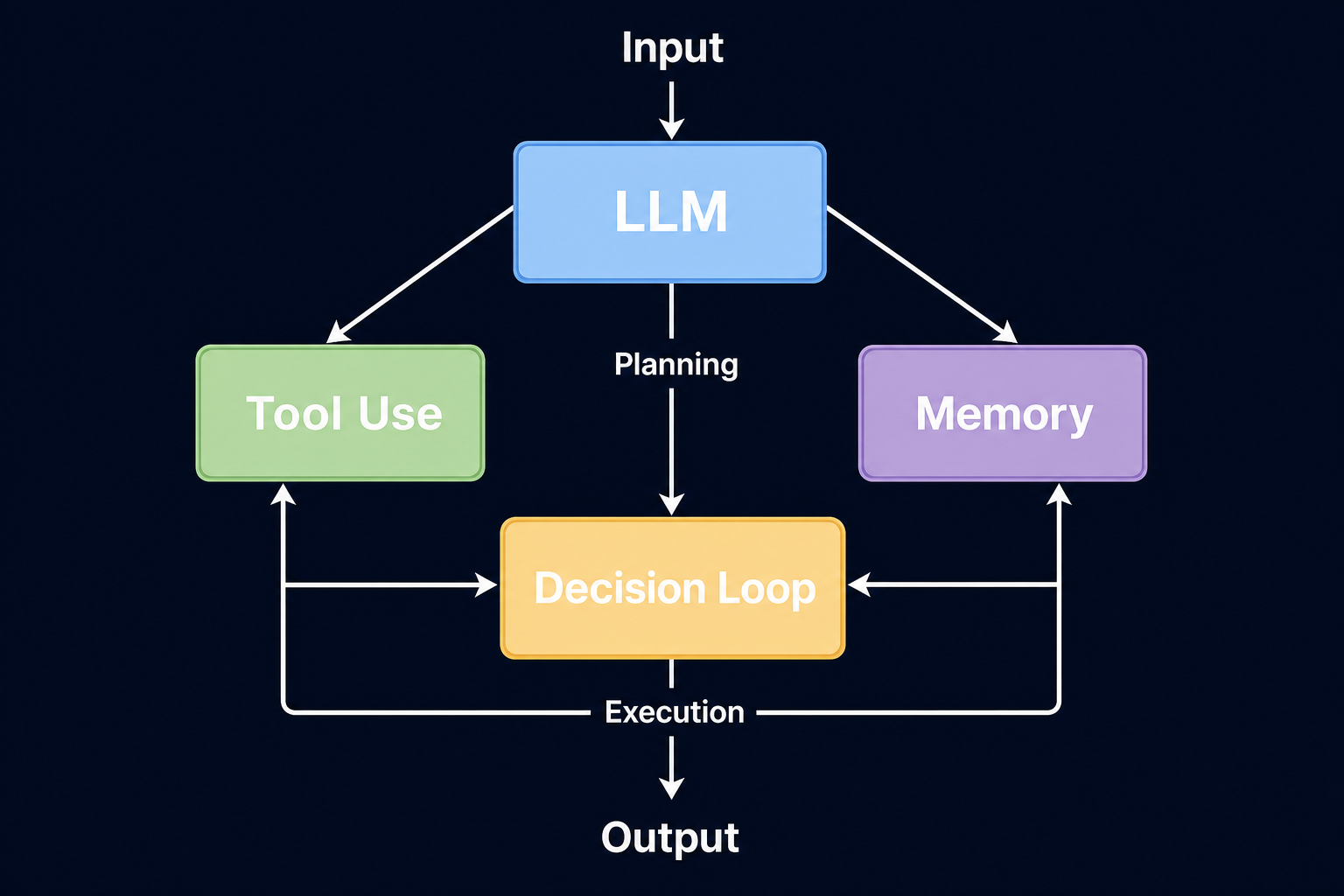
An autonomy.">AI agent, however, uses an LLM as its 'brain' but augments it with additional capabilities like memory, tool use, and a decision-making loop. This allows the agent to break down complex goals into sub-tasks, execute them sequentially, and learn from outcomes over time.
The agent orchestrates multiple LLM calls and other tools to achieve its objective.
LLM vs. Agent: The Decision Loop
This diagram highlights the fundamental difference in operational flow between a simple LLM and an AI agent. The LLM processes a single input to produce a single output, whereas the agent engages in a continuous, iterative cycle. This contrast reveals how agents achieve complex goals by breaking them into manageable steps and adapting to their environment.
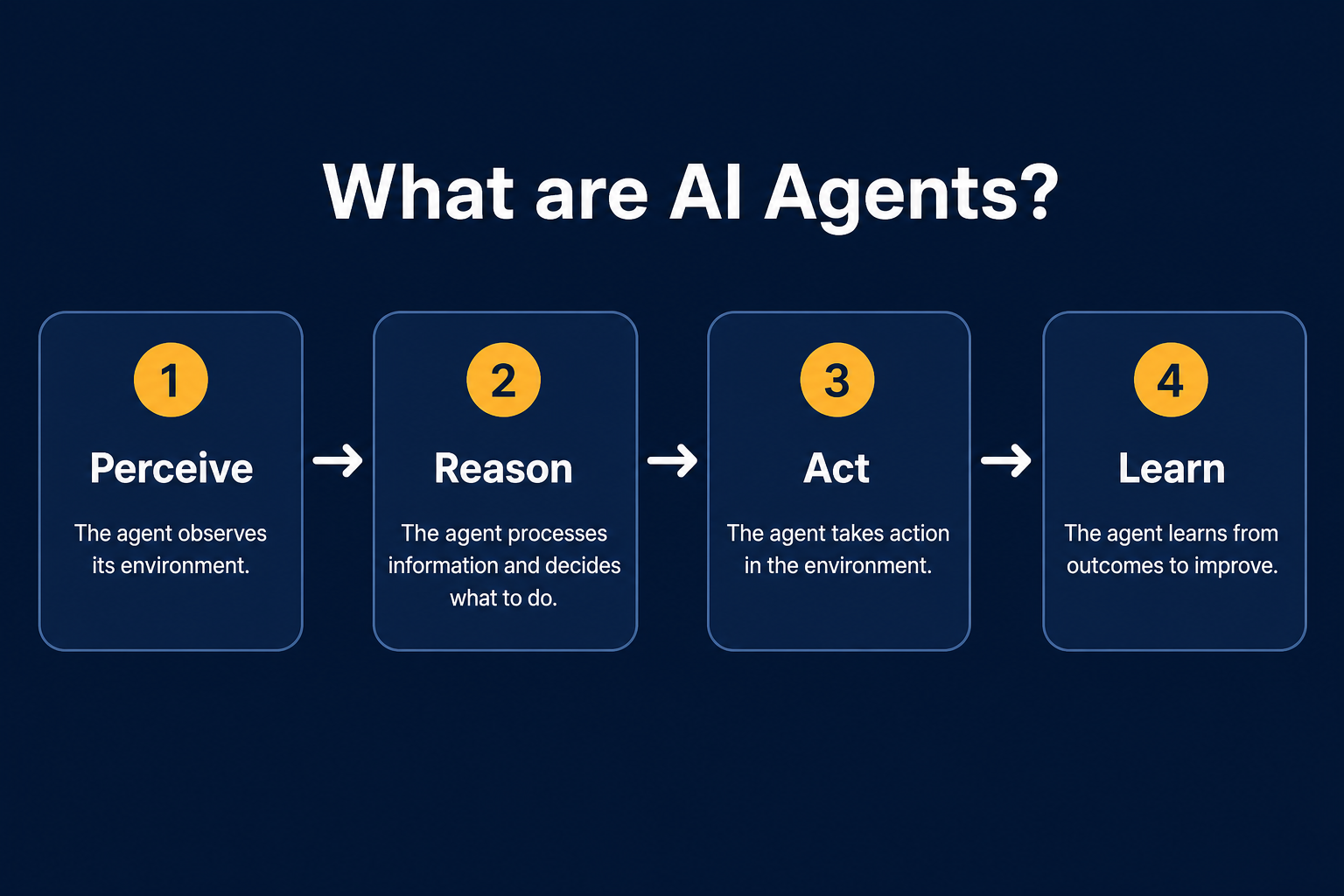
Following the sequence step by step makes What are AI Agents? straightforward to apply immediately.
Think of the LLM as the agent's reasoning core, providing the intelligence for planning and understanding. It processes information but doesn't act alone.
Agents use external tools (APIs, databases, web searches) to interact with the real world beyond language generation. These tools are their 'hands'.
The agent's power comes from its continuous loop of observation, decision, action, and learning. This allows for adaptation and complex problem-solving.
The Power of Autonomy
The ability of AI agents to operate autonomously transforms how we approach complex problems. They can manage dynamic situations, recover from errors, and adapt to new information without direct human intervention. This enables them to tackle tasks that are too tedious, fast-paced, or complex for manual execution.
This shift from reactive LLM use to proactive agentic systems is critical for building advanced AI applications. Understanding this fundamental concept opens the door to designing AI solutions that truly automate and optimise real-world processes. It moves beyond simple question-answering to active problem-solving.
Pause and reflect
How does the iterative loop of an AI agent contribute to its problem-solving capabilities?
Test Your Understanding
If you remember only three things…
Agents are autonomous
AI agents perceive, decide, and act to achieve goals independently. They are not passive tools.
LLMs are components
A Large Language Model often serves as the 'brain' within an agent, providing reasoning capabilities. It is not the agent itself.
Iterative loop is key
Agents operate through a continuous cycle of observation, planning, action, and reflection. This enables complex problem-solving.
Beyond text generation
Agents move AI beyond single-turn responses to proactive, goal-oriented system automation. This expands AI's real-world utility.
Term Glossary
4 verified conceptsUnderstanding the Agentic Shift
You now understand that AI agents are more than just LLMs; they are autonomous systems capable of complex, goal-oriented behaviour. This changes how you view AI's potential.
AI agents transform language models into active problem-solvers, making them truly autonomous.
The next lesson will explore the specific tools and capabilities that help AI agents to interact with their environment.
Audio lesson recap
A concise audio summary of this lesson — great for reinforcing key concepts on the go.
Hear it discussed
About three minutes on the ideas in this lesson
Sterling
AI tutor
Vivienne
Sceptical challenger
Press play to start the discussion…
Full transcript · click any line to jump
Ask anything about What are AI Agents?. Sterling will answer — concisely, and with his customary level of patience.