Quantization Fundamentals
This lesson introduces 8-bit integer quantization, a core technique for reducing AI model size and accelerating inference. You will learn the principles behind converting 32-bit floating-point numbers to 8-bit integers.
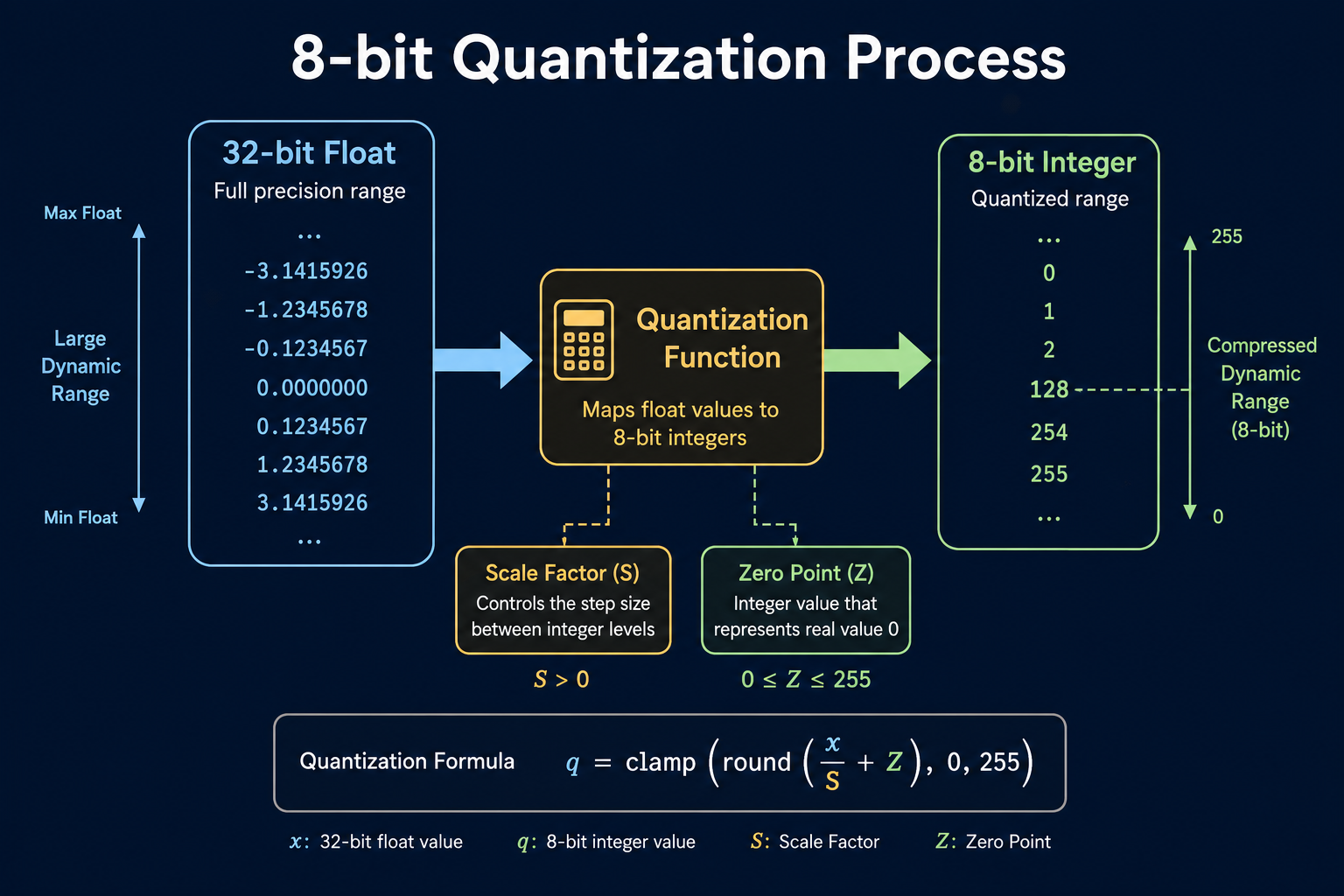
The Essence of Quantization
Quantization converts high-precision numbers, like 32-bit floating-point values, into lower-precision formats, typically 8-bit integers. This process reduces the memory footprint and computational cost of AI models significantly. It is like simplifying complex fractions into whole numbers for easier mental arithmetic.
The core mechanism involves mapping a range of floating-point numbers to a smaller range of integers. This mapping uses a 'scale factor' and a 'zero point' to preserve the relative relationships between values as much as possible. Each original floating-point value is scaled, shifted, and then rounded to its nearest integer representation.
Consider a model weight that ranges from -1.0 to 1.0. With 32-bit floats, this range is represented with high granularity. Quantizing to 8-bit integers maps this range, for example, to -127 to 127, where each integer now represents a specific float value. This compression is applied to weights and activations within the neural network.
This compression has a direct impact on real-world deployment. Smaller models load faster, consume less memory, and execute operations quicker on inference hardware. This enables sophisticated AI to run on edge devices, mobile phones, or in large-scale data centers with reduced energy consumption and latency.
Smaller models, faster inference: quantization makes AI practical.
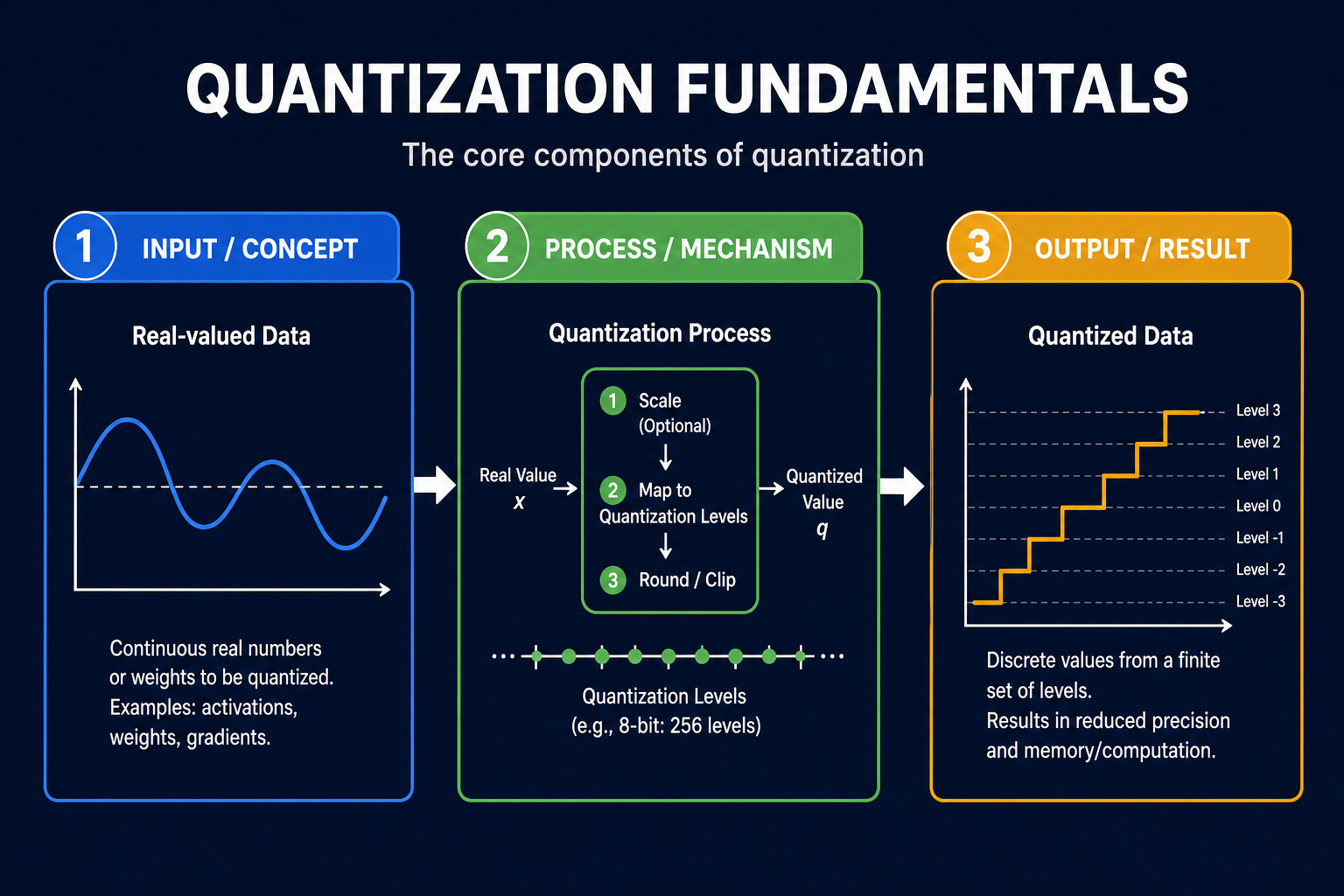
This diagram breaks down the core building blocks of Quantization Fundamentals so you can see how each part connects.
Before we begin
Why do massive AI models run so slowly on everyday devices? Their raw data takes up too much space and processing power, creating a bottleneck.
If you reduce the precision of numbers in an AI model from 32-bit to 8-bit, what is the primary benefit you expect?
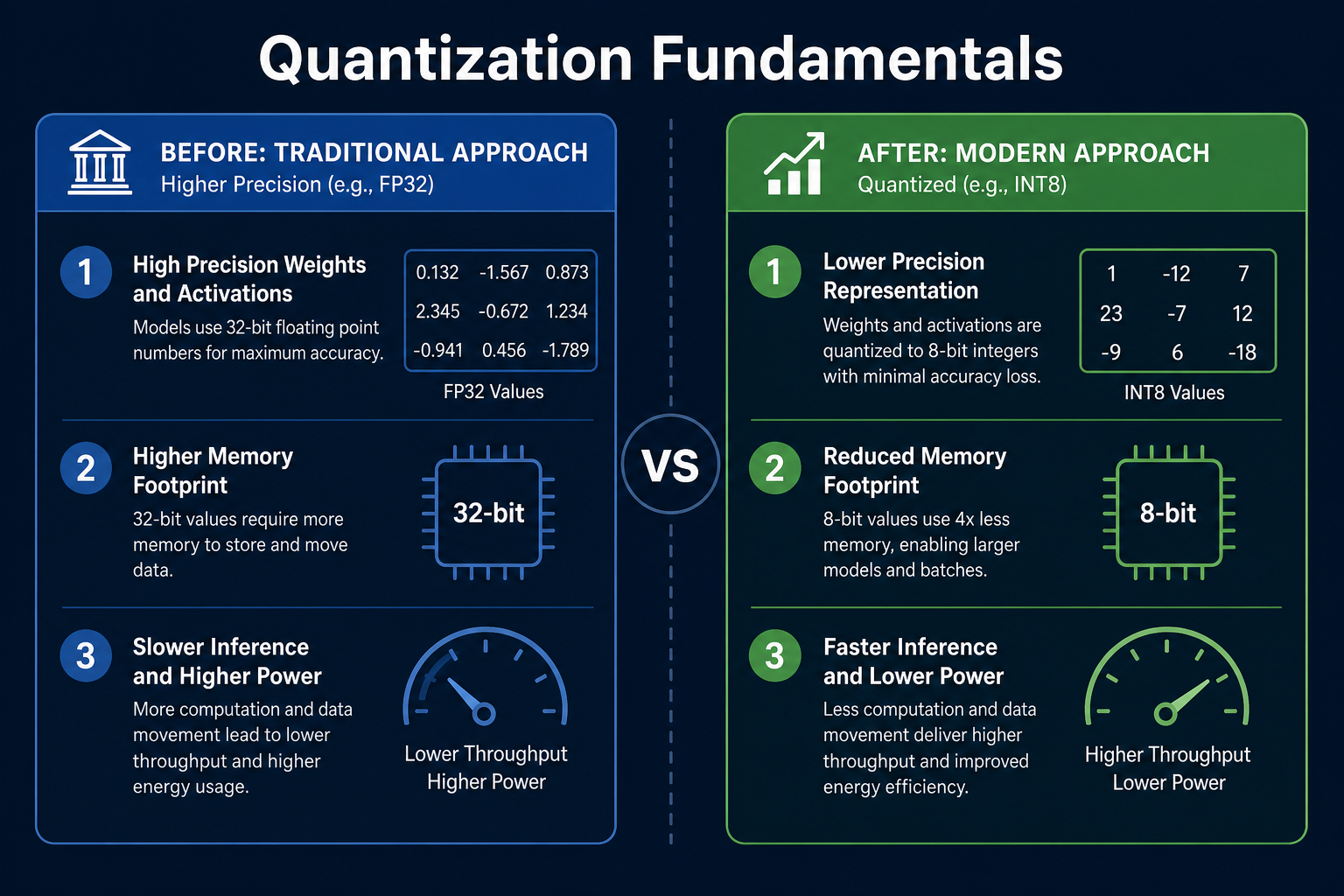
Comparing the old approach to the new one shows why Quantization Fundamentals matters in Future of AI Inference.
A Leap in AI Efficiency
You will see a live demonstration of quantization's impact on model performance metrics. This visual illustrates how reducing numerical precision directly translates to tangible efficiency gains in a deployment environment.
Quantization in Action
Observe the data compression in a real-world setting.
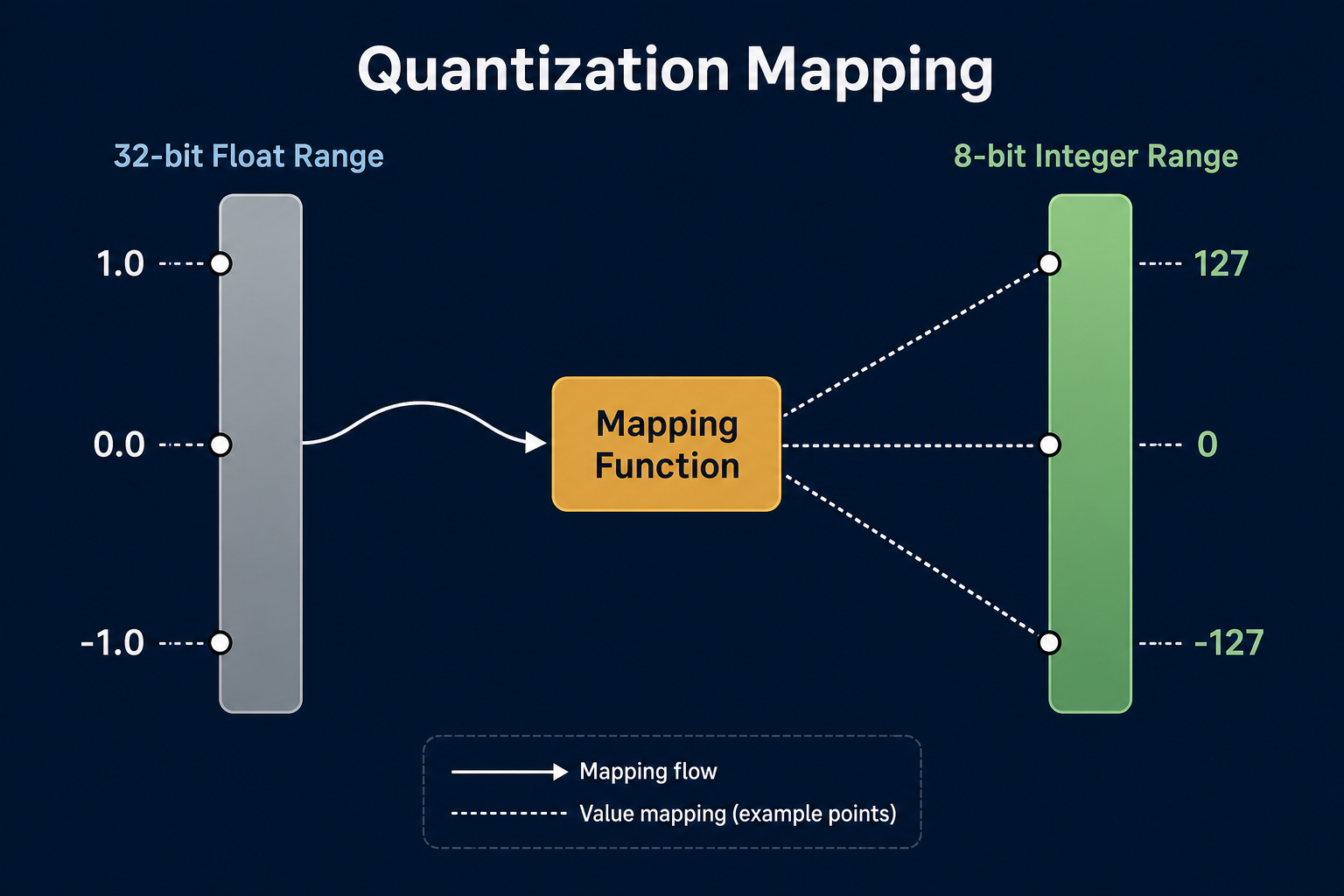
Mapping Float to Integer
Quantization: Before and After
This contrast diagram clearly shows the trade-offs and benefits of quantization. The 'before' state highlights the resource demands of high-precision models, while the 'after' state demonstrates the efficiency gains from using 8-bit integers. This transformation directly impacts deployment feasibility.
The Scenario
A startup develops a real-time object detection app for smartphones. Their initial 32-bit model was too slow and drained battery quickly.
The Challenge
Deploying a complex neural network on mobile hardware with limited processing power and memory proved impractical, leading to poor user experience.
The Resolution
Applying 8-bit quantization reduced the model size by 75% and boosted inference speed by 2-4x. This made the app responsive and battery-friendly, enabling successful product launch.
Quantization is a trade-off: you sacrifice some numerical precision for significant gains in speed and size. Modern techniques minimise accuracy loss.
While 8-bit is common, quantization can target other bit-widths like 4-bit or even 1-bit. The optimal choice depends on hardware and accuracy needs.
For best results, models are often 'quantization-aware trained'. This means the model learns to tolerate lower precision during its training phase.
Pause and reflect
How does 8-bit quantization primarily benefit AI model deployment, and what is the main trade-off?
Test Your Understanding
If you remember only three things…
Quantization reduces precision
Models convert from 32-bit floats to 8-bit integers. This compression shrinks model size and speeds up calculations.
Efficiency is the goal
Smaller models run faster, use less memory, and consume less power. This enables broader AI deployment.
Trade-offs are managed
Some numerical precision is lost, but modern techniques minimise accuracy degradation. The balance is key.
Term Glossary
4 verified conceptsThe Power of Precision Control
You now understand that controlling numerical precision is a effective lever for AI model optimization. This insight allows you to critically evaluate deployment strategies for real-world AI applications.
Precision is a choice, not a default; strategic reduction learn efficiency.
In the next lesson, we will explore model pruning, another critical technique for shrinking AI models without significant performance loss.
Audio lesson recap
A concise audio summary of this lesson — great for reinforcing key concepts on the go.
Hear it discussed
About three minutes on the ideas in this lesson
Sterling
AI tutor
Vivienne
Sceptical challenger
Press play to start the discussion…
Full transcript · click any line to jump
Ask anything about Quantization Fundamentals. Sterling will answer — concisely, and with his customary level of patience.