When the lab building AI starts using AI agents to do its own research, the pace of AI development just entered a feedback loop — and the implications for every knowledge worker are immediate.
The Lab That Ate Its Own Cooking
OpenAI has published internal data showing that coding agents are now deeply embedded in how its own researchers work — accelerating experiment velocity, and taking on increasingly complex, longer-running tasks, though they still need significant human steering as complexity rises.
This isn't a product announcement. It's a window into what happens when the most sophisticated AI tools on the planet are pointed inward, at the very people designing the next generation of AI. The feedback loop is real, and it's already running.
AI Agents Reshaping Research: The Business Impact
The data OpenAI shares covers agent usage rates, task complexity handled autonomously, and measurable gains in research throughput. In plain terms: researchers are running more experiments and shipping code faster, with agents doing more of the day-to-day work -- though people still set priorities and judge results. That's a direct analogue to what's coming for R&D teams, consultancies, and any organisation that runs on intellectual labour.
The ethical tension here is sharp. If AI agents can accelerate AI research this much (OpenAI reports 3.1 agent-workdays of effort for every workday of human labor), who governs the speed? Faster capability development without proportional safety review is precisely the scenario that AI governance frameworks like those explored in Leading AI Assurance are designed to address. The lab eating its own cooking is impressive — but the kitchen is getting very hot, very fast.
For industry observers, this also signals a structural shift: organisations that deploy AI agents internally will compound their advantages over those that don't. The gap between AI-native firms and laggards isn't linear — it's accelerating.
The Architecture Behind the Acceleration
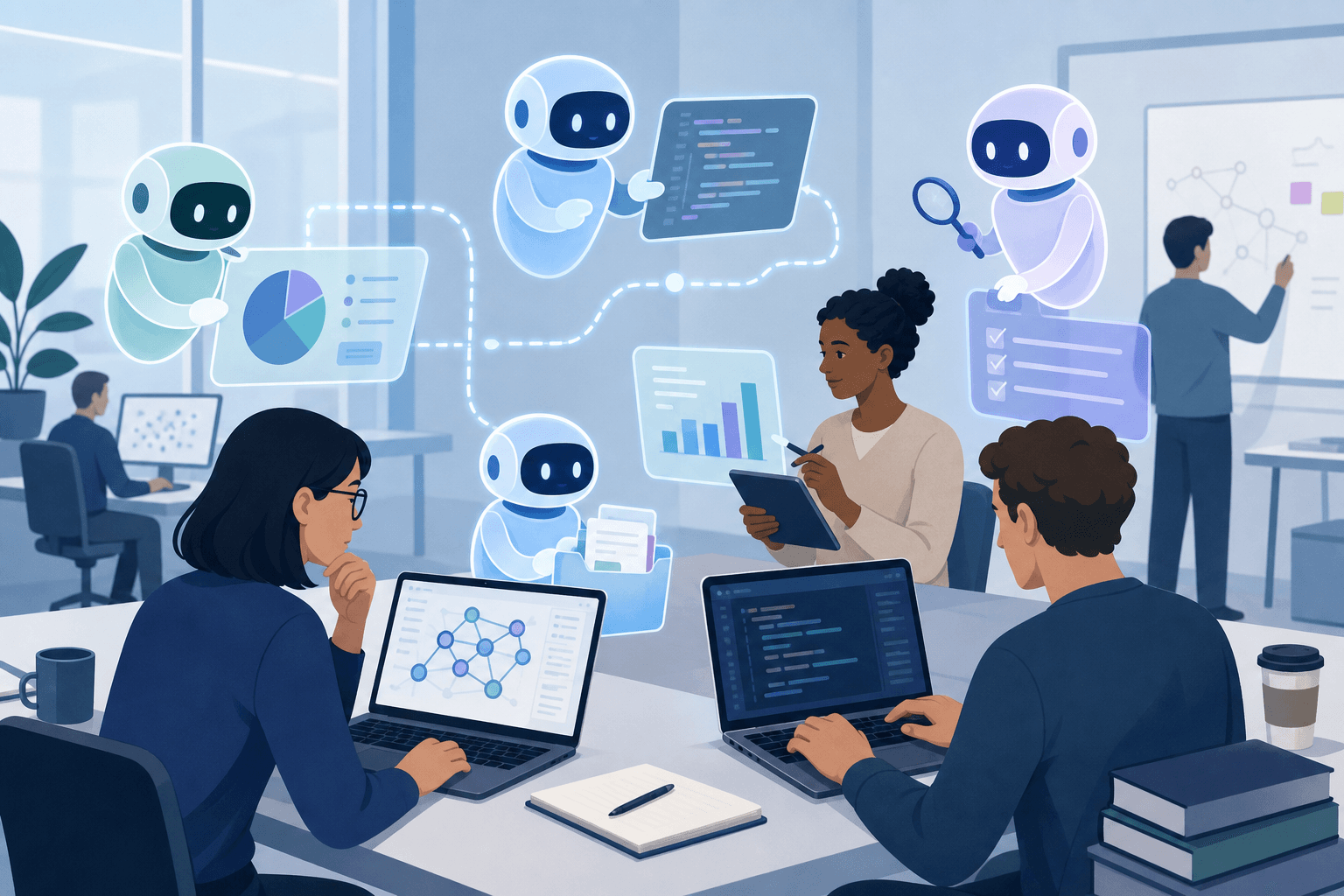
Coding agents are contributing to more experiments and handling more complex tasks, though people still set priorities, judge which results to pursue, and decide when to scale, pause, or deploy systems. OpenAI's internal deployment suggests a multi-agent workflow where autonomous systems handle the iterative grunt work while human researchers focus on higher-order decisions. If you want to understand how these systems are actually structured, Multi Agent Architecture That Actually Works breaks down the real mechanics.
The experiment velocity data is the most telling signal. More experiments per unit time means more chances to find what works — a compounding advantage that scales with agent capability. This is why even modest gains in agent reliability translate into outsized research outcomes.
What This Means for Learners
If the world's leading AI lab is restructuring its own research workflows around AI agents, that's your clearest signal yet about where professional leverage is heading. Understanding how agents are orchestrated, where they fail, and how humans stay meaningfully in the loop is no longer optional knowledge for anyone in a technical or strategic role.
The practical takeaway: start treating AI agents as collaborators in your own workflows now, not as a future curiosity. The organisations building fluency today are the ones who will set the pace tomorrow — just as OpenAI is demonstrating from the inside.