When AI starts reviewing its own work, the role of the human engineer shifts permanently — and that shift is now happening in production.
The Business Impact of Self-Testing AI Agents
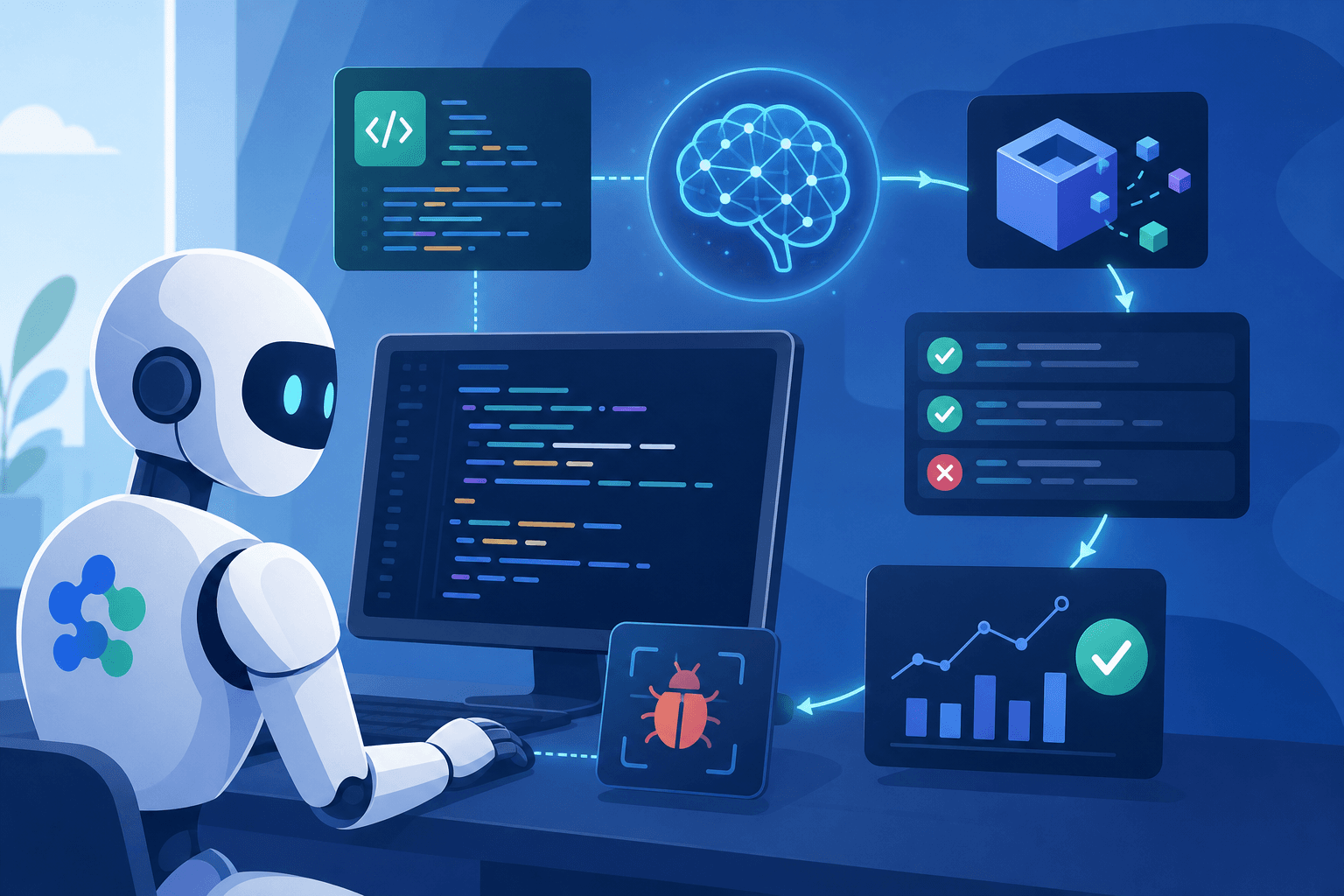
Cognition's Devin — the AI software engineer that made headlines for autonomously writing and deploying code — has just gained a critical new capability: using GPT-6 Astra to test its own output before a human ever sees it. That's not a minor feature update. That's a fundamental change to the software development pipeline.
The practical upshot for engineering teams is fewer pull request reviews, faster shipping cycles, and — if it works as advertised — fewer bugs reaching production. For CTOs and engineering leads, this is the kind of compound automation that meaningfully changes headcount planning.
The model here is significant: Astra acts as an evaluator layer on top of Devin's generative work, essentially closing a quality-control loop that previously required human eyes. One AI writes; another AI judges. Engineers step in only when both agree something needs escalation.
Why AI-on-AI Evaluation Changes the Industry Shift Calculus
The broader industry implication is that AI agent workflows are maturing from "AI does a task" to "AI does a task and verifies it." That's a qualitatively different level of autonomy, and it raises real governance questions that businesses can't afford to ignore.
Who is accountable when an AI-tested, AI-written feature ships a bug? The legal and compliance frameworks for AI-generated software are still catching up — most enterprise contracts still assume a human reviewed the code. This integration quietly obsoletes that assumption at scale.
There's also a concentration risk worth naming: when both the generation and the evaluation layer are powered by OpenAI models, organisations are placing significant trust in a single vendor's quality standards. Diversified AI stacks suddenly look less like over-engineering and more like sensible risk management. If you want to understand how these multi-agent systems are architected, our course Inside the Swarm breaks down exactly how agent-to-agent evaluation loops are designed.
What This Means for Learners
If you're an engineer, a product manager, or anyone whose job touches software delivery, this story is a direct signal: the bottleneck is moving. It's no longer "can we build it?" — it's "can we govern what AI builds on our behalf?"
The skills that hold value in this new environment are prompt engineering for agent tasks, understanding how to set evaluation criteria for AI outputs, and knowing when to trust the loop versus when to break it. Our AI Agents course covers the foundations of how autonomous agents make decisions — essential context for anyone working alongside tools like Devin.
The engineers who thrive won't be the ones who write the most code. They'll be the ones who design the best guardrails for AI that writes code for them.