Defining AGI
This lesson clarifies the vital distinction between Artificial General Intelligence and the narrow AI systems we encounter daily.
Your AGI process Starts Now
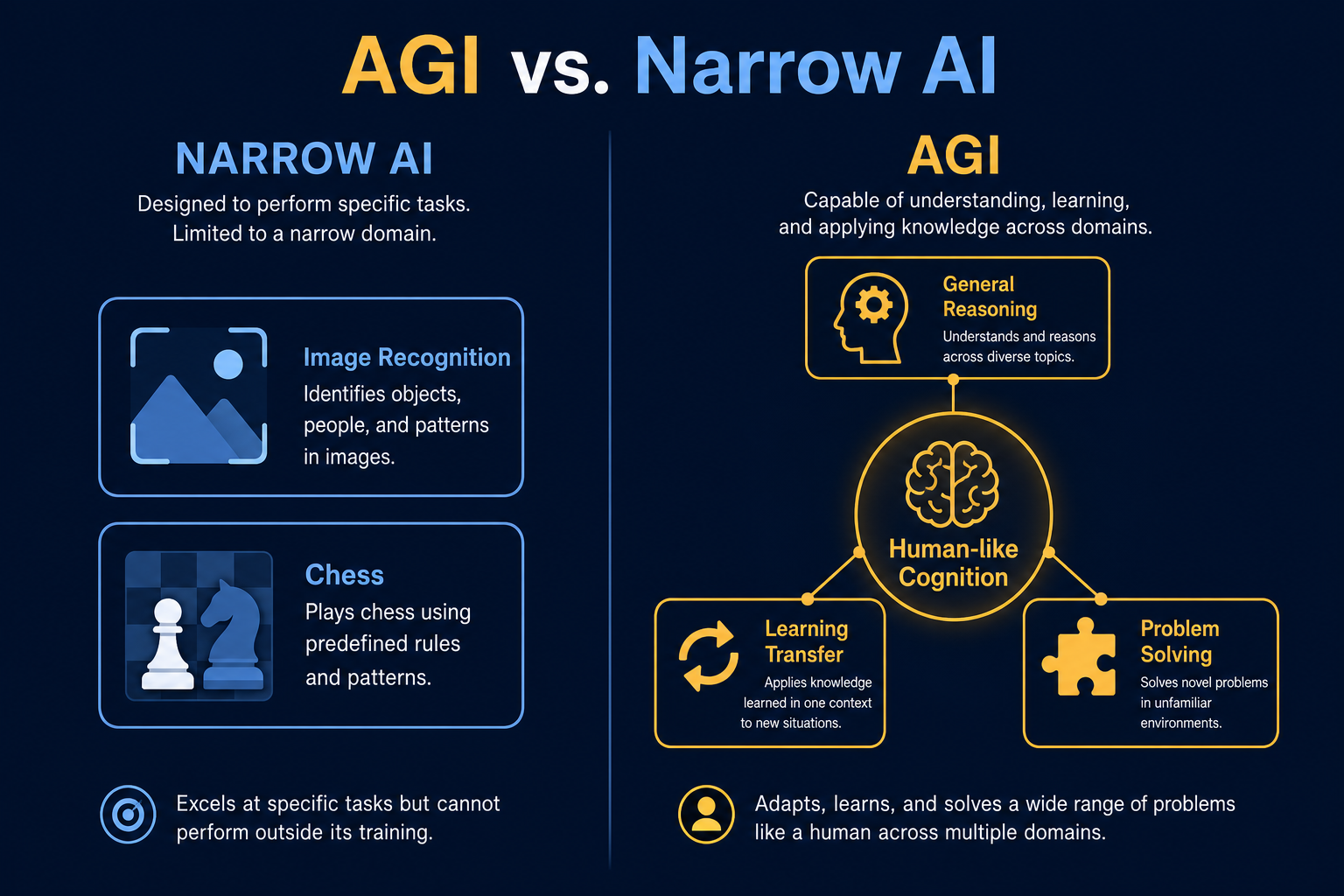
AGI means adapting to any task, not just excelling at one.
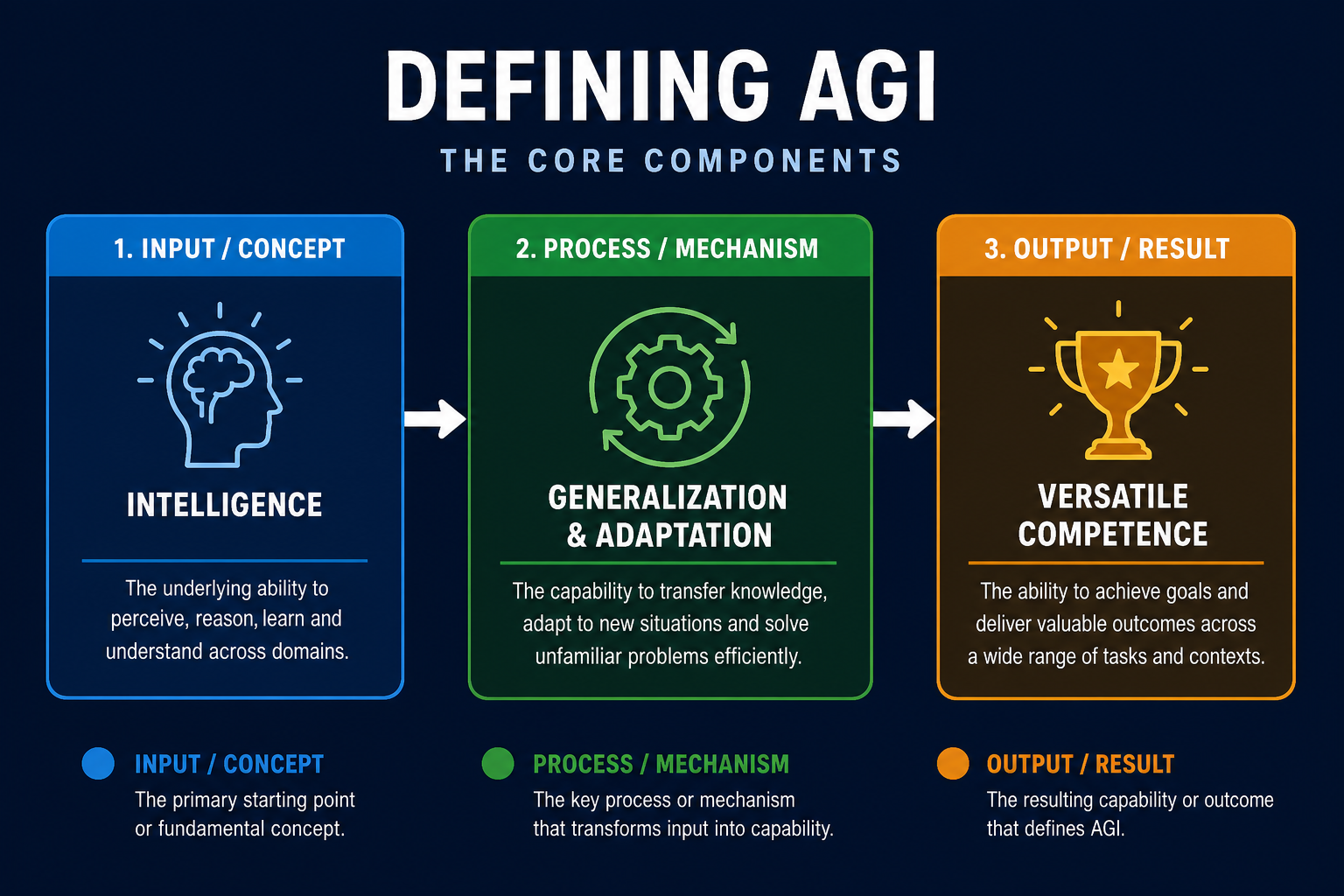
This diagram breaks down the core building blocks of Defining AGI so you can see how each part connects.
This clip visualises the aspiration for AGI systems capable of general reasoning and problem-solving across diverse domains. It highlights the research environment pushing towards this advanced form of intelligence.
The AGI Vision
Envisioning a future with adaptable AI.
Which characteristic truly defines Artificial General Intelligence (AGI)?
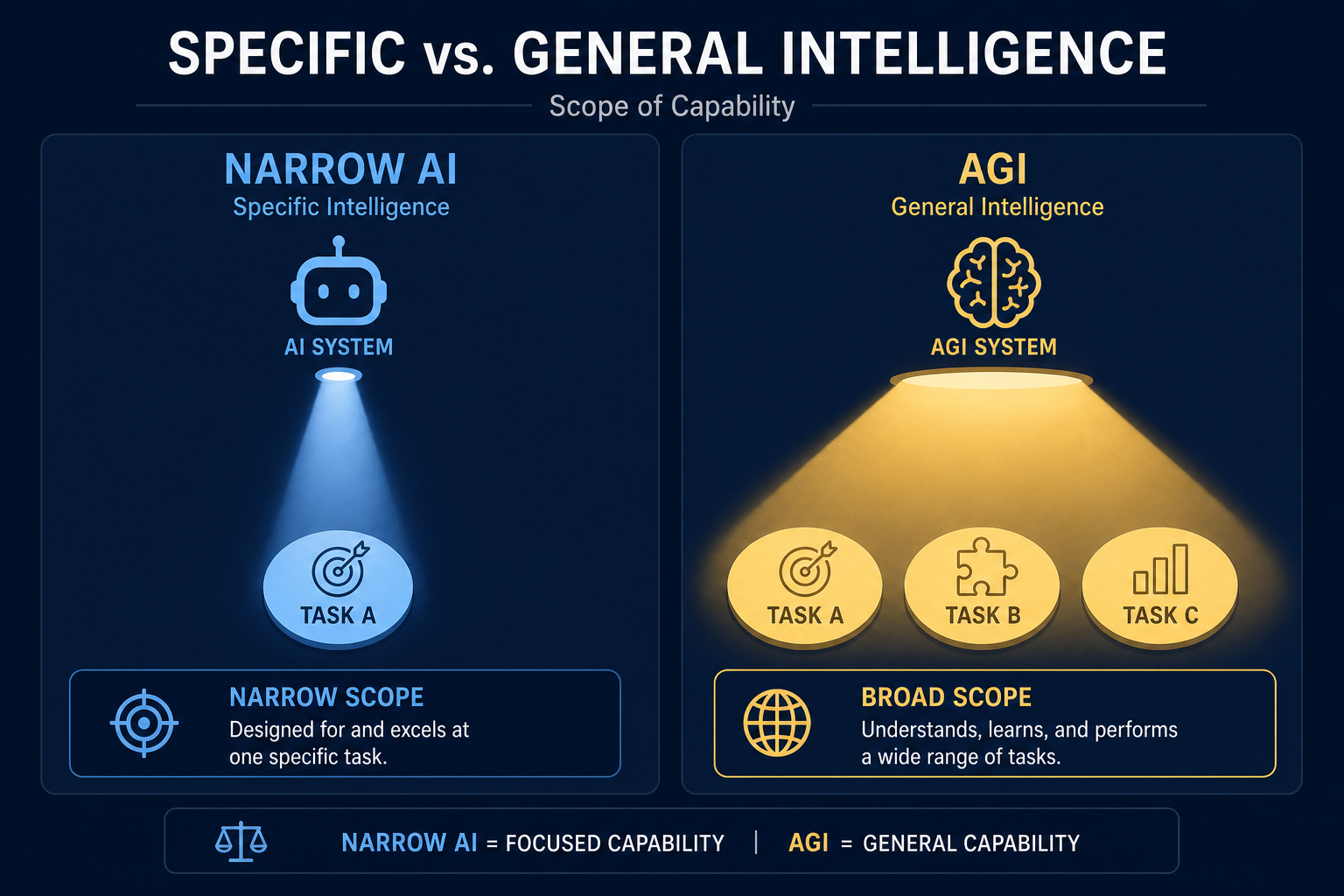
Narrow AI vs. AGI: A Fundamental Difference
The Core of General Intelligence
What truly sets AGI apart is its capacity for generalisation and abstraction. It can take knowledge learned in one context and apply it effectively to a completely different one. This mirrors how human intelligence functions.
This ability allows AGI to adapt to novel situations, learn new skills, and understand complex concepts without explicit pre-programming for every single scenario. It moves beyond pattern recognition to genuine comprehension.
Consider a human learning to ride a bicycle; they can then quickly grasp how to ride a scooter or even a unicycle. An AGI would exhibit similar transfer learning, applying general principles rather than just rote memorisation.
This flexibility is what makes AGI a truly significant concept, distinguishing it from even the most advanced narrow AI systems today.
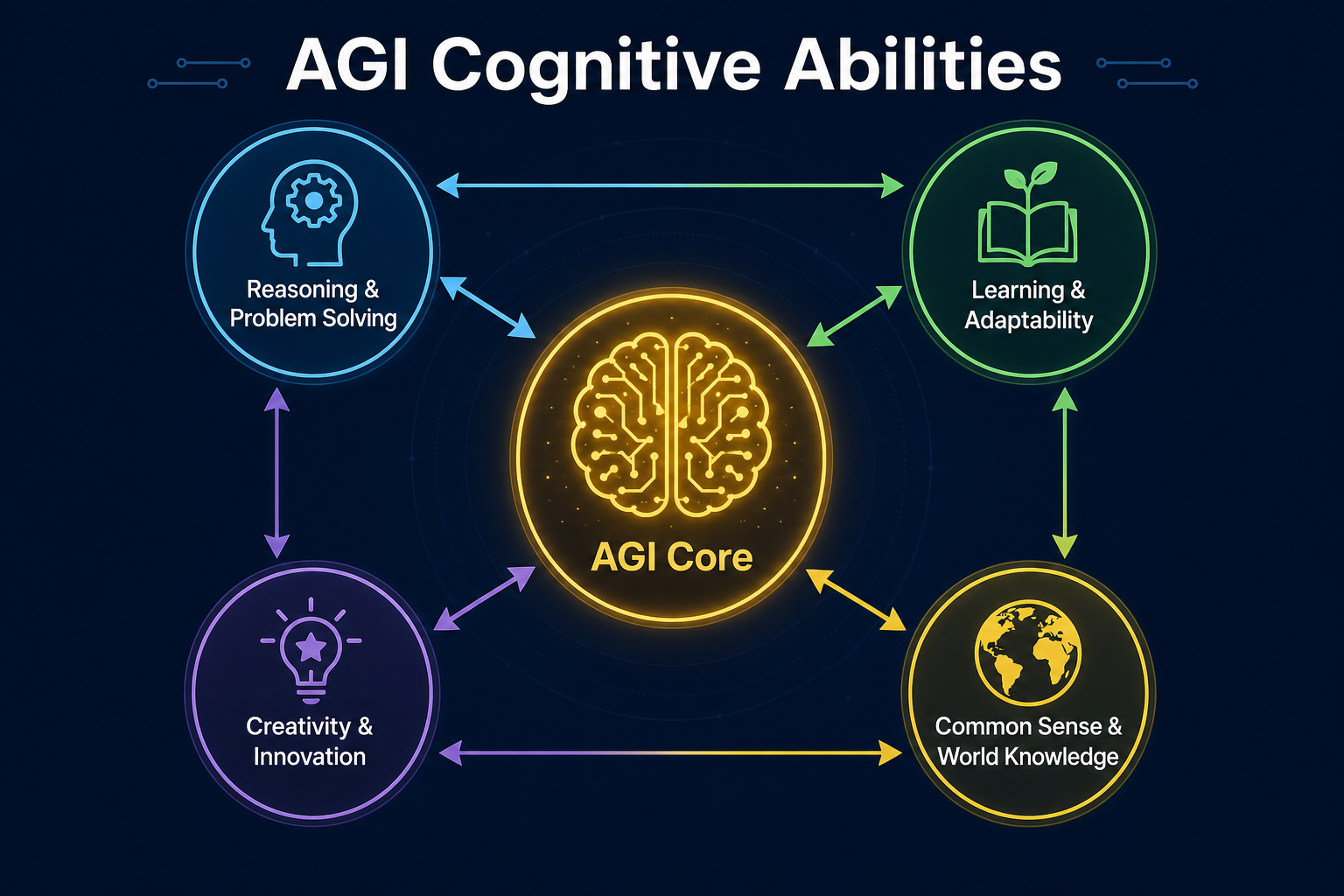
This diagram illustrates the multifaceted nature of AGI, showing it as an integrated system of diverse cognitive functions. It demonstrates that AGI is not merely an advanced calculator but a synthesiser of understanding, capable of dynamic interaction between learning, reasoning, and creative thought. The connections highlight that these abilities are interdependent, forming a cohesive intelligence rather than isolated skills.
How AGI Learns vs. Narrow AI
This contrast diagram highlights the fundamental difference in how Narrow AI and AGI acquire and apply knowledge. Narrow AI follows a linear, task-specific path, leading to deep but narrow expertise. AGI, conversely, integrates diverse inputs to build a flexible knowledge base, allowing for broad application. This demonstrates why AGI is considered a 'general' intelligence, capable of evolving beyond its initial training.
Narrow AI excels at one thing; AGI would excel at anything. This shift from specialised tools to a general cognitive agent marks a profound change.
The ability to transfer learning from one domain to another is a hallmark of true intelligence. This is what current AI systems largely lack.
AGI will not need retraining for every new problem. It would understand and adapt to the world in a human-like, intuitive way.
This video illustrates AGI's potential to assist with complex, multi-faceted real-world problems requiring broad understanding. It highlights the collaborative human-AGI interface for strategic decision-making.
Envisioning AGI's Impact
A glimpse into a future shaped by adaptable AI.
Navigating the Path to AGI
Achieving AGI presents immense technical and conceptual challenges. We must move beyond current data-driven pattern matching to systems capable of genuine understanding and common-sense reasoning.
This requires breakthroughs in areas like symbolic reasoning, causal inference, and value alignment. The path involves not just more effective algorithms, but fundamentally new architectural approaches. We are building the foundations for systems that can learn not just 'what' but 'why'.
If you remember only three things…
AGI is Generalised
AGI can adapt and apply intelligence across any intellectual task, unlike Narrow AI which excels only in specific, pre-defined domains.
Learning Transfer is Core
A key characteristic of AGI is its ability to transfer knowledge and skills from one context to an entirely new one, mirroring human cognition.
Challenges Remain
Achieving AGI requires significant breakthroughs in reasoning, common sense, and ethical alignment, moving beyond current AI's limitations.
Impact is Broad
The development of AGI would fundamentally reshape industries and human capabilities, offering solutions to complex, multi-domain problems.
Test Your Understanding
Term Glossary
4 verified conceptsThe Generalisation Horizon
You now understand the profound difference between today's specialised AI and the envisioned adaptable intelligence of AGI. This distinction redefines the future of AI development and its potential impact across all domains.
AGI promises an intelligence that learns and adapts, not just executes predetermined tasks.
The next lesson will explore the major organisations leading the race to develop AGI and their strategic approaches.
Audio lesson recap
A concise audio summary of this lesson — great for reinforcing key concepts on the go.
Hear it discussed
About three minutes on the ideas in this lesson
Sterling
AI tutor
Vivienne
Sceptical challenger
Press play to start the discussion…
Full transcript · click any line to jump
Ask anything about Defining AGI. Sterling will answer — concisely, and with his customary level of patience.