Centralised vs. Decentralised Control
Discover the trade-offs between centralised and decentralised control in multi-agent systems.
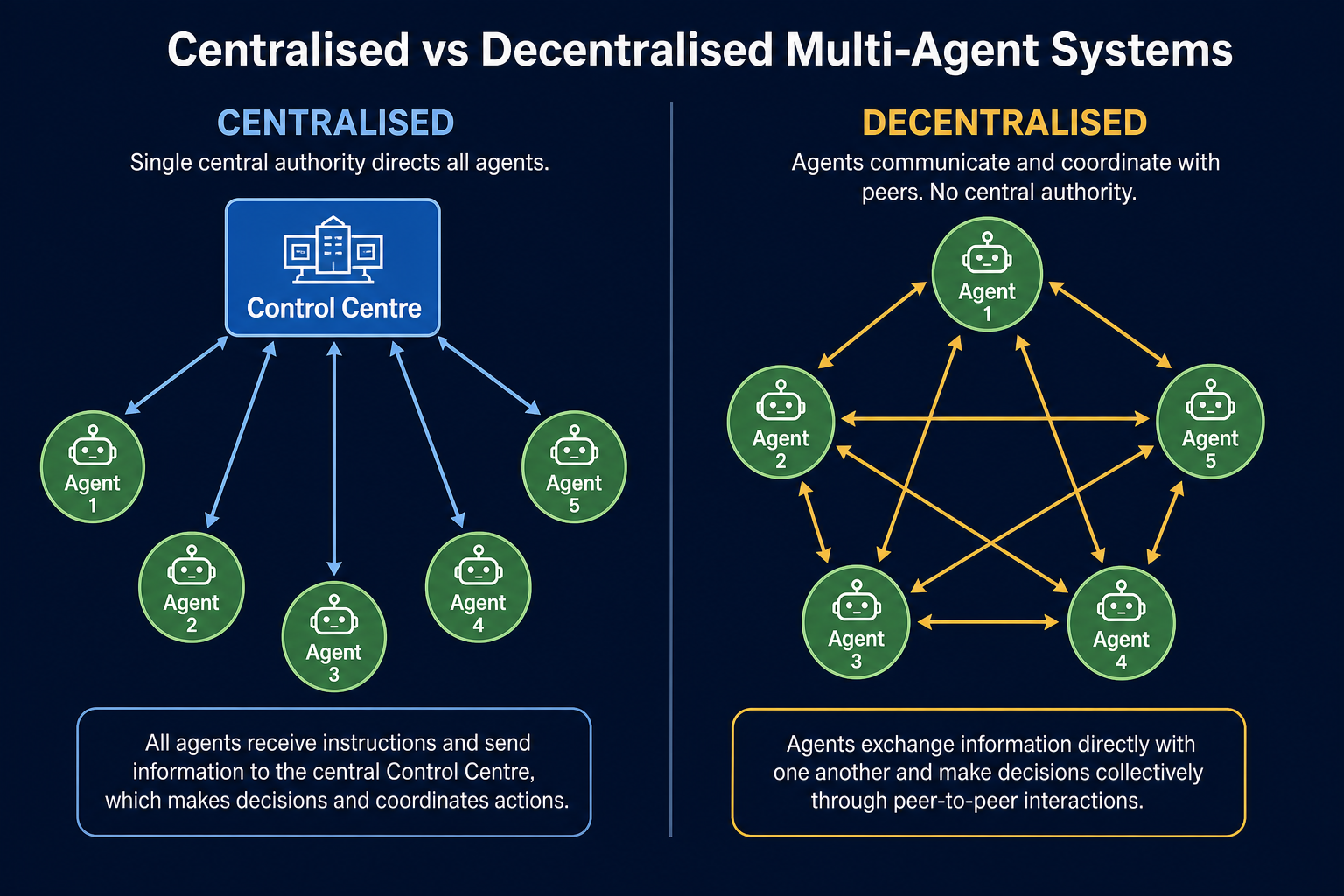
Centralised Control Explained
global optimisation and consistent decision-making.">Centralised control operates much like a conductor leading an orchestra. A single entity manages all aspects of the system, making decisions and issuing commands. This approach simplifies coordination, as all information flows through one central point.
The central controller gathers data from all agents, processes it, and then sends instructions back to the agents. This allows for global optimisation and consistent decision-making across the entire system. However, it also introduces a single point of failure.
Imagine a smart factory where a central server controls all the robots. The server knows the status of each machine, the inventory levels, and the production schedule. By coordinating everything from one place, the factory can maximise efficiency.
global optimisation and consistent decision-making.">Centralised control works well when the environment is predictable and the system is relatively small. However, as the system grows or the environment becomes more complex, the central controller can become a bottleneck.
The best control architecture depends on the problem, not just the possibilities.
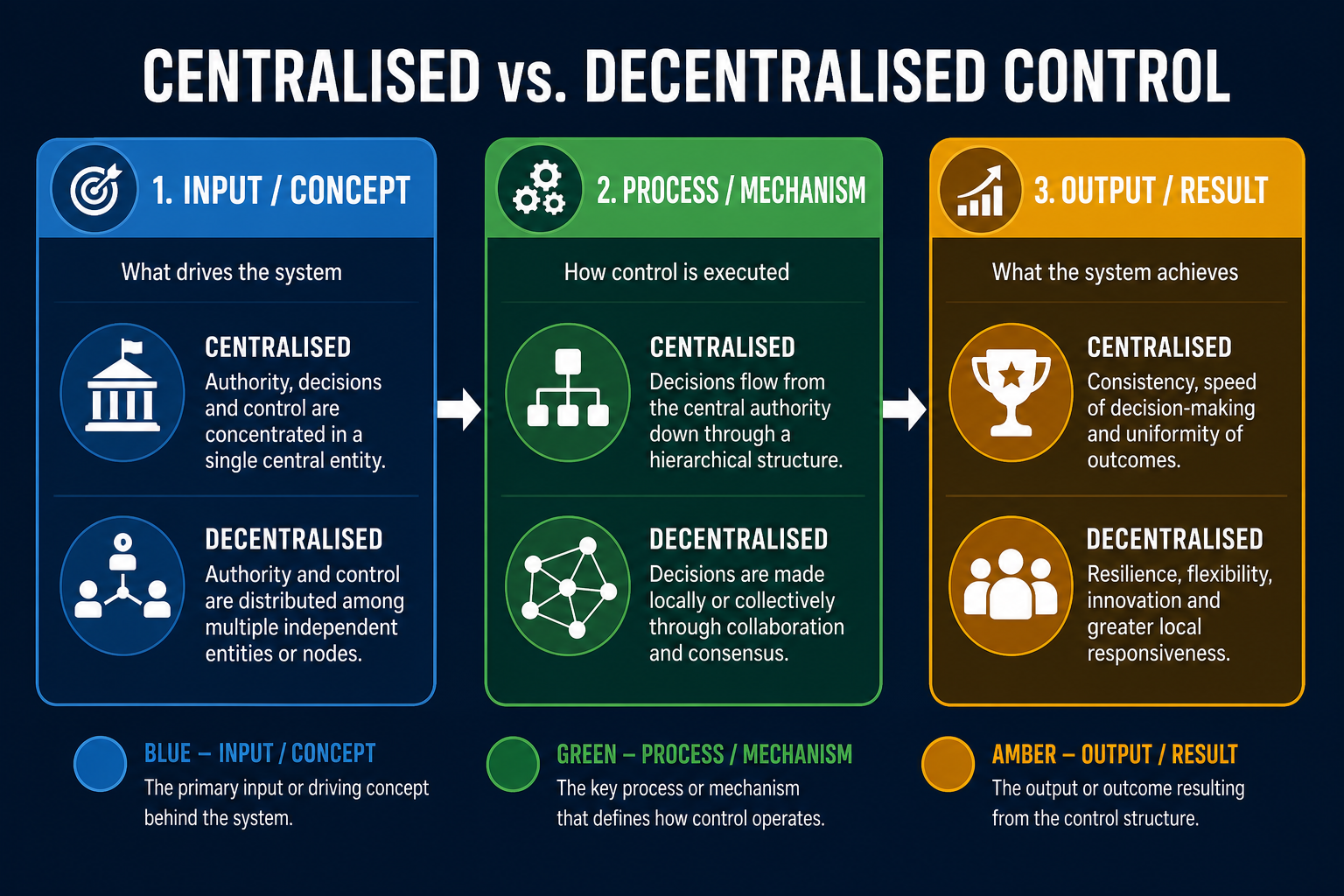
This diagram breaks down the core building blocks of Centralised vs. Decentralised Control so you can see how each part connects.
This video demonstrates how a centralised system can manage complex interactions. It showcases a real-world application of centralised control.
Centralised System Simulation
A simulation of a centralised control system in action.
Which control architecture is generally more resilient to individual component failures?
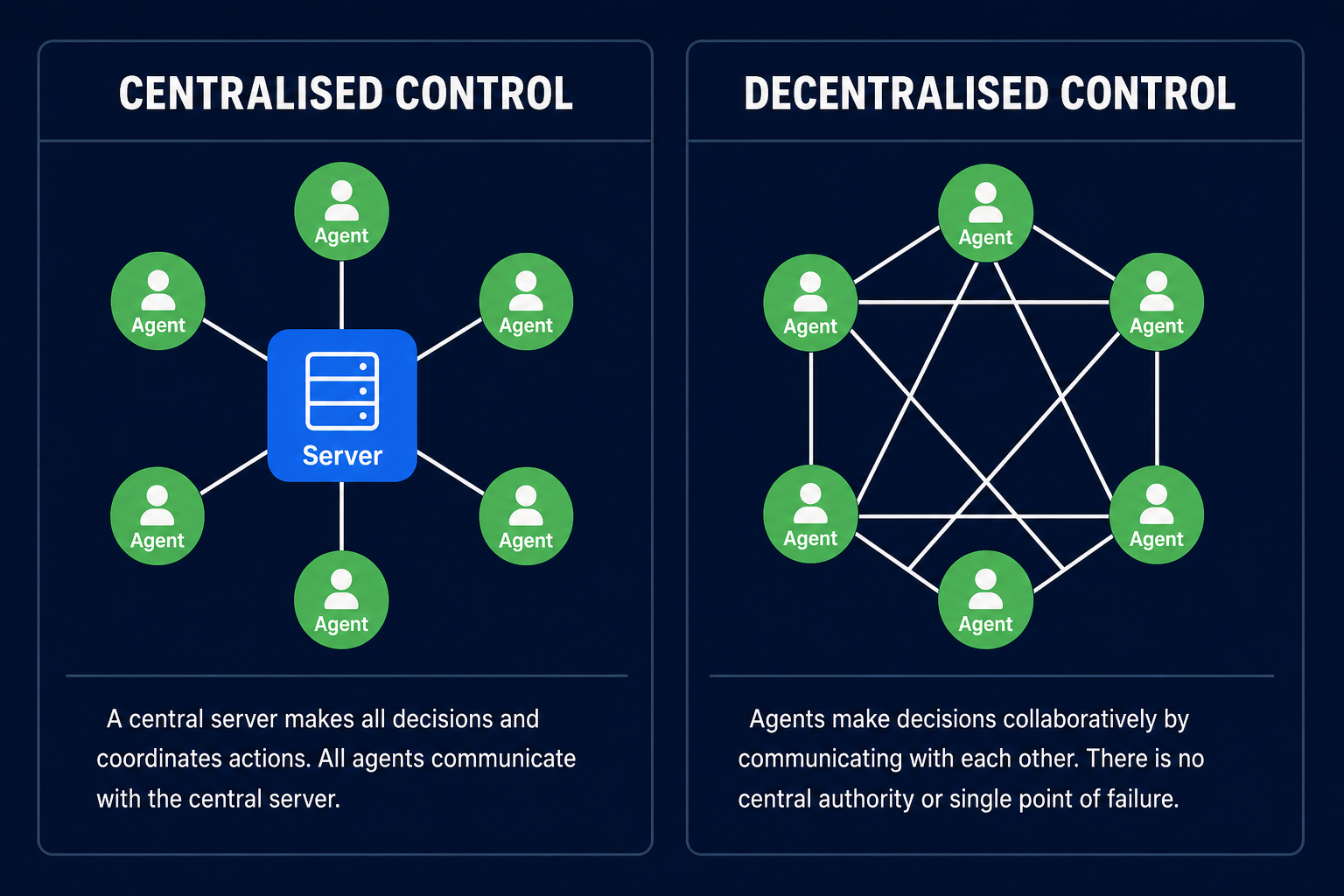
Control Architectures
Decentralised Control Explained
Decentralised control, on the other hand, resembles a flock of birds navigating together. Each agent makes decisions based on its own local information and interactions with nearby agents. There is no single leader or central authority.
Agents communicate directly with each other, sharing information and coordinating their actions. This distributed approach allows the system to adapt quickly to changes in the environment. It also makes the system more reliable to failures, as the loss of one agent does not cripple the entire system.
Consider a swarm of drones performing search and rescue operations. Each drone independently explores the area, communicating with its neighbours to avoid collisions and share discoveries. This allows the swarm to cover a large area quickly and efficiently.
Decentralised control is ideal for dynamic and uncertain environments where agents need to be adaptable and resilient. However, it can be more challenging to achieve global optimisation and ensure consistent behaviour across the system.
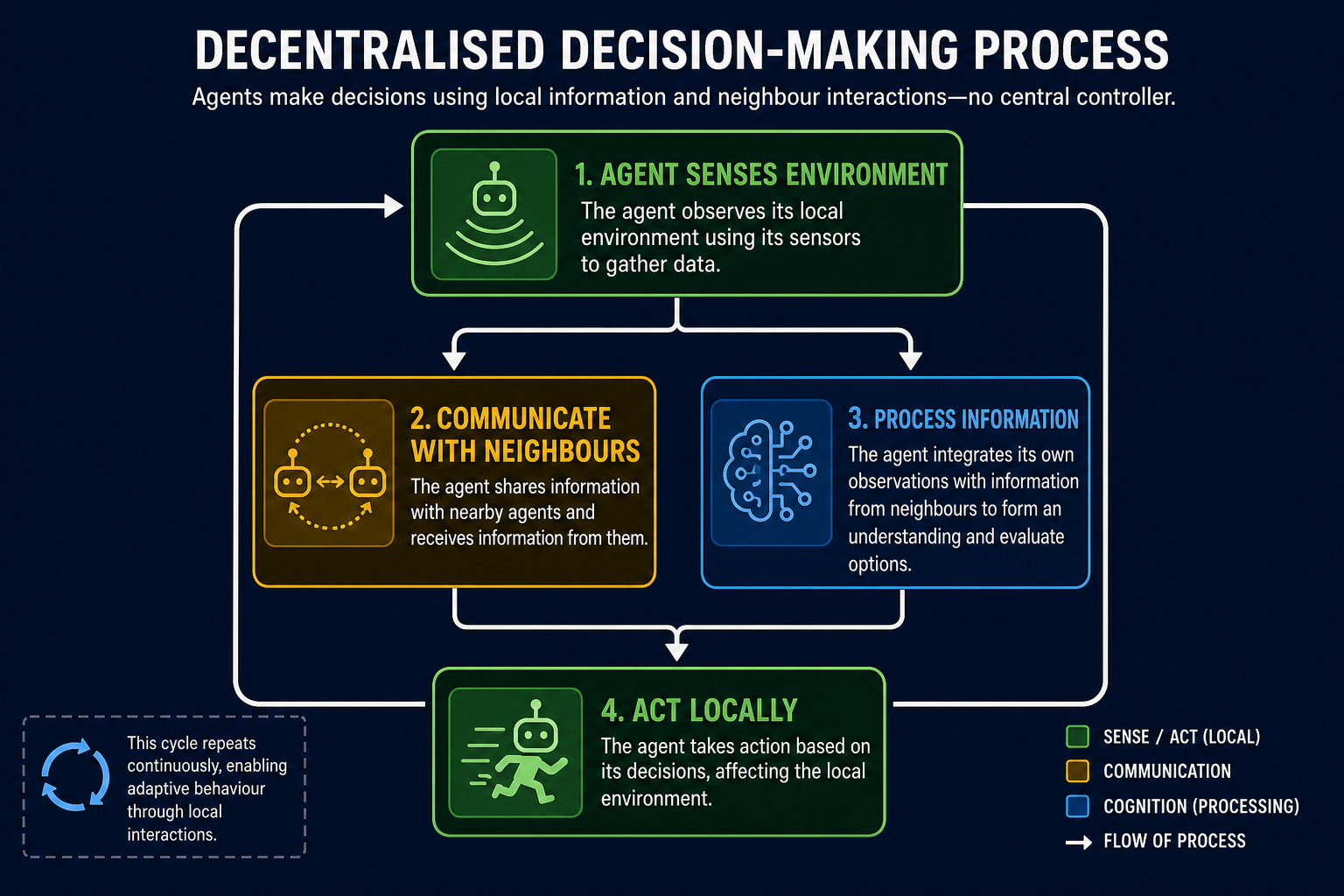
This process highlights how local interactions drive overall system behaviour. Each agent contributes to the collective intelligence without relying on a central command.
Centralised vs. Decentralised: A Contrast
This contrast illustrates the fundamental difference in information flow and decision-making. Centralised systems optimise for global efficiency, while decentralised systems prioritise adaptability and robustness.
Centralised systems are easier to design initially but can become unwieldy as complexity grows. Decentralised systems are more complex to design but scale more gracefully.
Decentralised systems offer inherent redundancy and fault tolerance. Centralised systems are vulnerable to single points of failure.
Decentralised control allows for quicker reactions to local changes. Centralised control can introduce delays due to communication overhead.
This video shows how a decentralised swarm can accomplish a task without central coordination. It illustrates the power of distributed intelligence.
Decentralised Robot Swarm
A demonstration of a decentralised robot swarm coordinating a task.
Choosing the Right Architecture
Selecting the right control architecture is a crucial step in designing effective multi-agent systems. The choice depends on factors such as the environment, the complexity of the task, and the desired level of robustness.
global optimisation and consistent decision-making.">Centralised control is suitable for well-defined tasks in predictable environments. Decentralised control is better suited for dynamic and uncertain environments where agents need to adapt and respond quickly to changes.
If you remember only three things…
Centralised Control
A single entity manages the entire system, enabling global optimisation. This is effective in predictable environments but vulnerable to single points of failure.
Decentralised Control
Agents make decisions based on local information and interactions, allowing for adaptability and resilience. This is ideal for dynamic and uncertain conditions.
Complexity Trade-offs
Centralised systems simplify initial design, but decentralised systems scale more gracefully. Consider the long-term growth and maintainability of the system.
Real-World Applications
Traffic management systems (centralised) and robot swarms (decentralised) demonstrate the practical applications of each architecture. The application determines the best control strategy.
Test Your Understanding
Prompt AI to Compare Traffic Control Architectures
Write a prompt that asks an AI to compare and contrast centralized and decentralized control architectures for a smart city traffic management system. Focus on key advantages and disadvantages of each.
You are developing a smart city traffic management system using multi-agent AI. The core decision is whether to employ a single, powerful AI orchestrating all traffic lights and routes (centralized control) or to deploy individual, local AI agents at each intersection making real-time decisions based on immediate sensor data (decentralized control). You need an AI to help you understand the architectural implications for this specific application.
Term Glossary
4 verified conceptsFrom Choice to Capability
You now understand the trade-offs between centralised and decentralised control, and how architecture affects system performance. You can now choose the right approach for your specific needs.
The choice between centralised and decentralised control shapes the behaviour and capabilities of multi-agent systems.
Next, we'll explore the role of communication protocols in multi-agent coordination.
Audio lesson recap
A concise audio summary of this lesson — great for reinforcing key concepts on the go.
Hear it discussed
About three minutes on the ideas in this lesson
Sterling
AI tutor
Vivienne
Sceptical challenger
Press play to start the discussion…
Full transcript · click any line to jump
Choose architecture based on environment
The optimal control architecture, whether centralised or decentralised, hinges on the specific problem and environmental conditions. Centralised systems suit predictable settings, whilst decentralised systems thrive in dynamic ones.
Centralised control: single point efficiency
Centralised systems offer global optimisation and consistent decision-making through a single coordinator. However, this approach introduces a single point of failure and can become a bottleneck in large or complex systems.
Decentralised control: adaptable and resilient
Decentralised systems achieve adaptability and robustness by distributing decision-making among multiple agents. This approach avoids single points of failure and allows for quick responses to environmental changes.
Ask anything about Centralised vs. Decentralised Control. Sterling will answer — concisely, and with his customary level of patience.