RAG Architecture Overview
Explore the fundamental components and interactions within a Retrieval-Augmented Generation (RAG) pipeline.
Knowledge Base Fundamentals
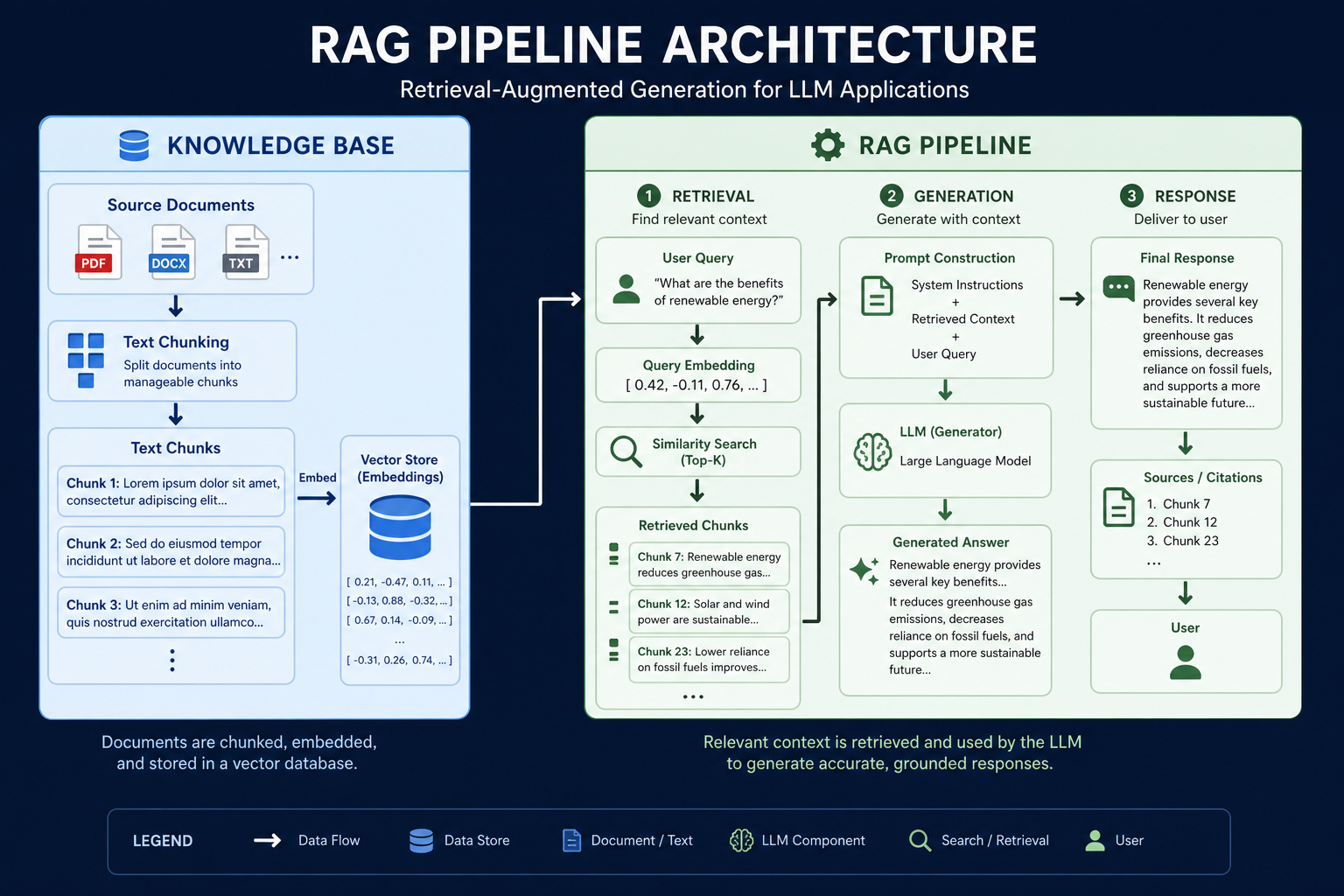
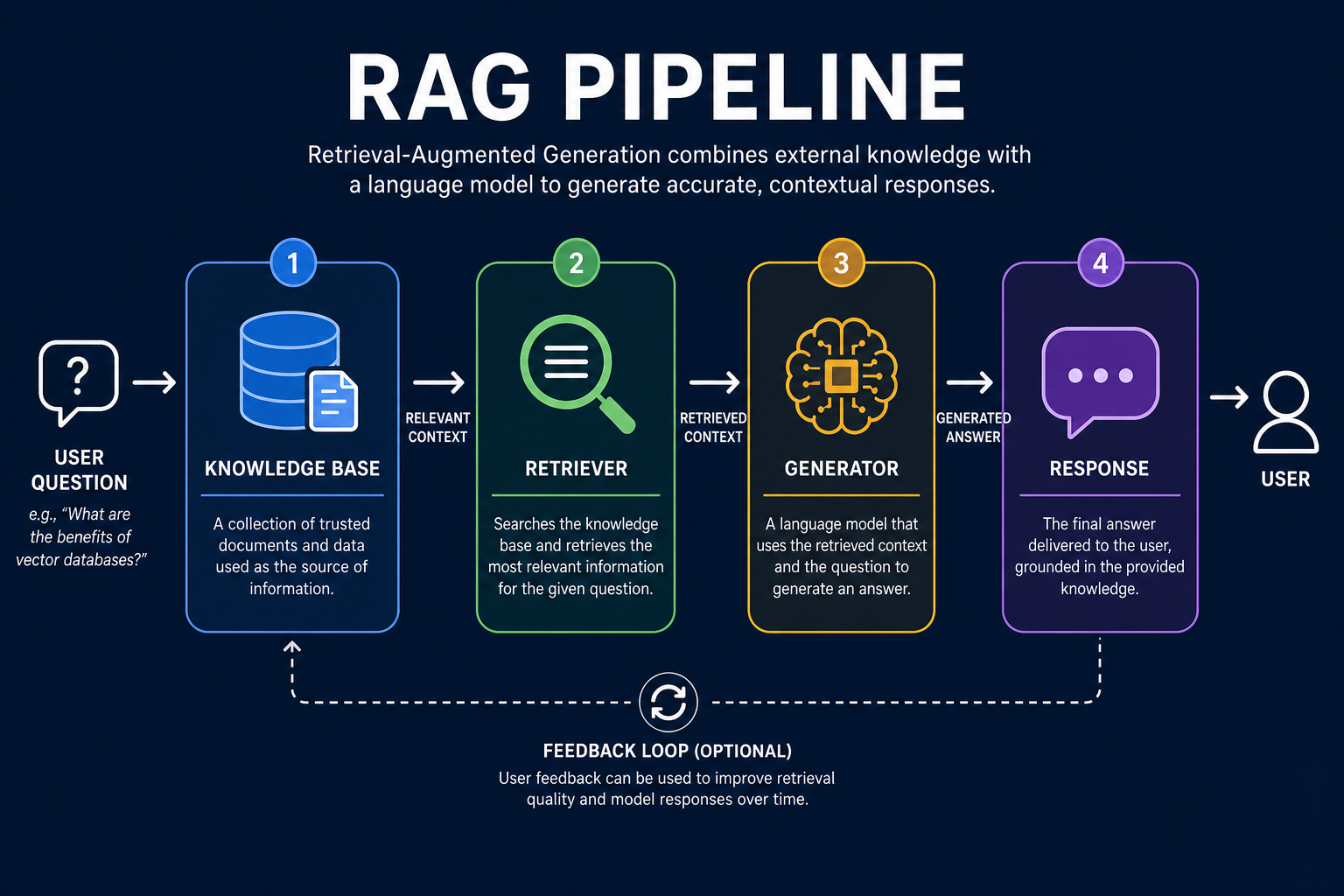
A RAG pipeline starts with a knowledge base. This is a collection of documents, articles, or any other data source that the model can use to answer questions. A well-structured knowledge base is crucial for the success of the entire pipeline.
The knowledge base needs to be processed into a format that the retriever can use. This usually involves chunking the text into smaller pieces and embedding them into a vector space. This allows for efficient similarity searches.
RAG pipelines transform static knowledge into dynamic, context-aware responses.
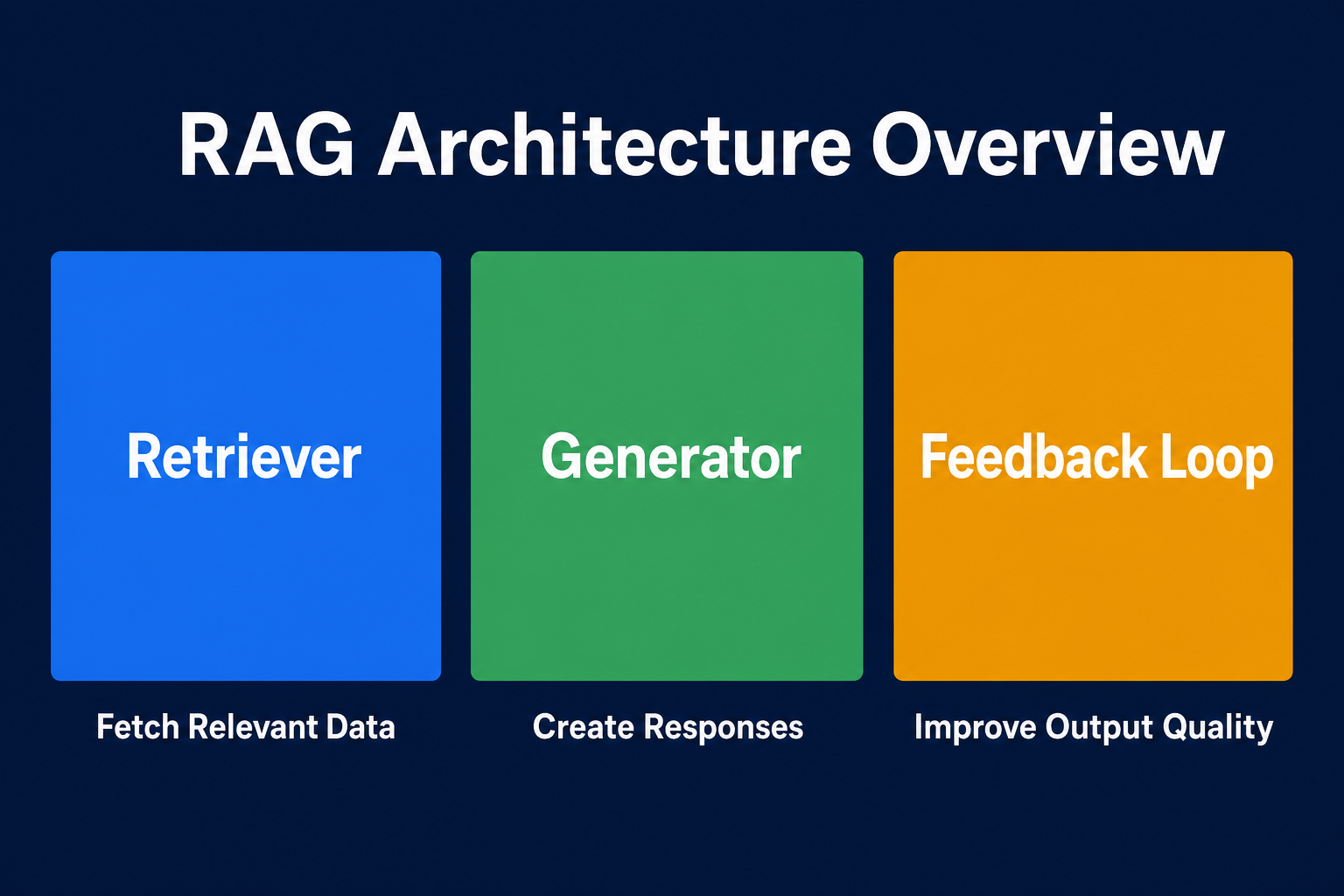
This diagram breaks down the core building blocks of RAG Architecture Overview so you can see how each part connects.
This video shows a simplified RAG pipeline in action. It illustrates the process of transforming data into a context-aware response.
RAG Pipeline in Action
See a simplified RAG pipeline visualized.
Which of these components is NOT a core part of a RAG pipeline?
Key Elements of a RAG System
Retrieval and Generation Stages
The retriever identifies relevant chunks from the knowledge base based on the user's query. It uses techniques like semantic similarity to find the most pertinent information. The quality of the retriever directly impacts the relevance of the generated response.
The generator uses the retrieved information and the user's query to create a coherent response. It combines the external knowledge with its internal knowledge to provide an answer. LangChain provides tools to manage both retrieval and generation stages.
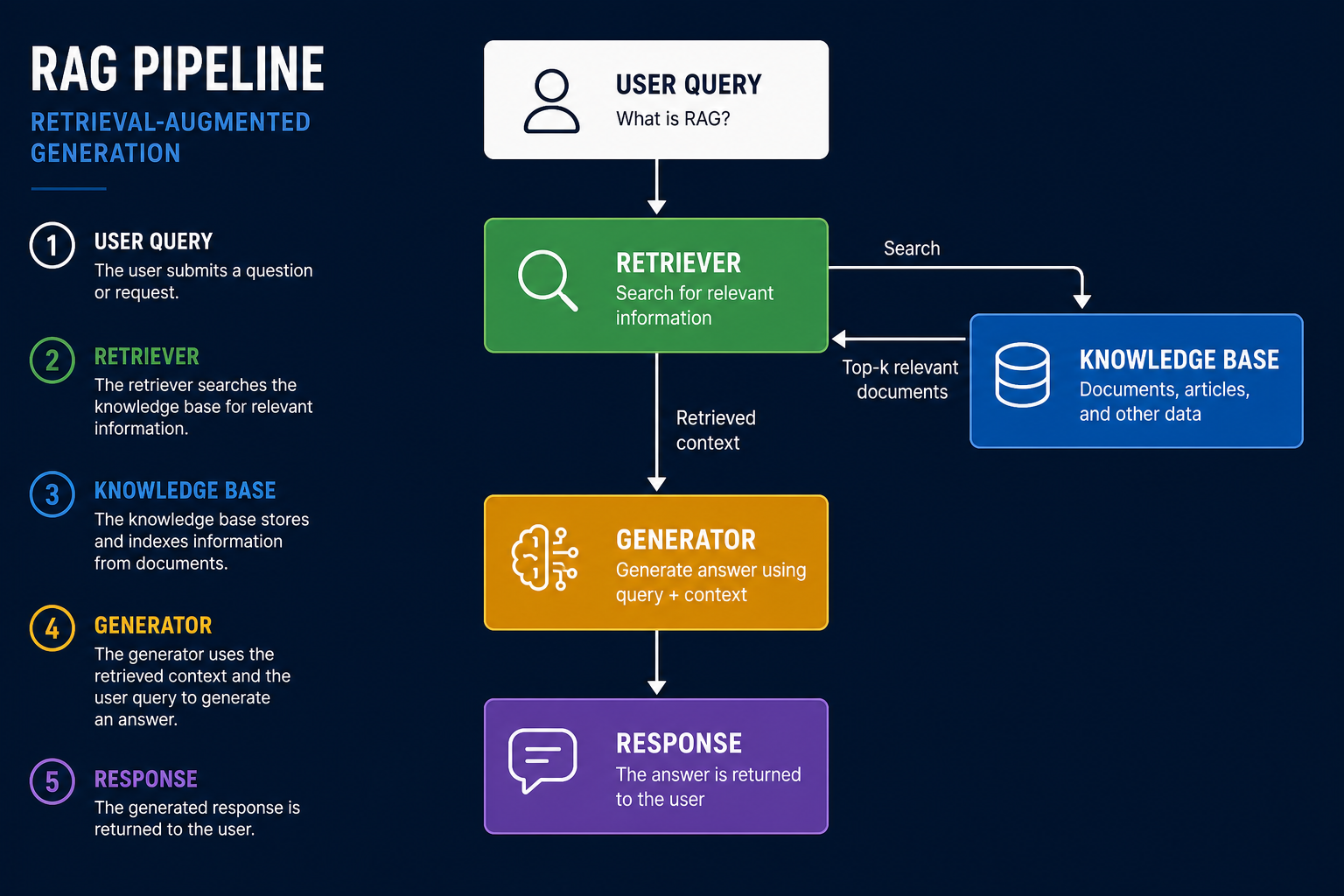
This diagram shows how a user query triggers the retrieval of relevant information. This retrieved information is then used by the generator to create a response.
RAG Pipeline: Before and After
This contrast reveals the impact of RAG on response quality. By incorporating external knowledge, RAG pipelines provide more accurate and contextually relevant answers than models relying solely on internal data.
RAG shines when external context is crucial. It enables AI to answer questions that would otherwise be impossible.
LangChain abstracts away the complexities of RAG. It provides tools for building and managing each component.
RAG pipelines can be customized. You can optimize retrieval and generation for specific use cases.
This video shows RAG being used to search through a large document database. It highlights the ability of RAG to retrieve relevant information from external sources.
RAG in Document Retrieval
See RAG being used to search through a large document database.
RAG Optimization
Optimizing a RAG pipeline is an iterative process. It involves fine-tuning each component to achieve the best results. Experimentation with different retrieval and generation strategies is key.
Evaluation metrics are crucial for measuring RAG pipeline performance. Metrics like relevance and accuracy help identify areas for improvement. Continuous monitoring ensures the pipeline remains effective.
If you remember only four things…
Knowledge Base
The foundation of any RAG pipeline. It provides the external knowledge for generating context-aware responses.
Retriever
Identifies relevant information from the knowledge base. Its accuracy directly impacts the quality of the response.
Generator
Combines retrieved information with the user's query. It creates a coherent and informative response.
LangChain
A framework for building RAG pipelines. It provides tools for managing each component of the architecture.
Test Your Understanding
Instruct LLM to Use Context
Complete the prompt template. Your addition should clearly instruct the LLM on how to use the provided `[DOCUMENT_CONTENT]` to answer the `[USER_QUESTION]`, and what to do if the answer isn't present.
A core step in RAG is instructing the LLM to use the retrieved context effectively. Complete the prompt below to ensure the model prioritizes and correctly processes the provided `[DOCUMENT_CONTENT]` when answering the `[USER_QUESTION]`. This integration prevents hallucinations and grounds the response. Prompt: You are an intelligent assistant. Use the following document to answer the user's question. Document: ``` [DOCUMENT_CONTENT] ``` [BLANK] User Question: [USER_QUESTION]
Term Glossary
4 verified conceptsThe RAG Architecture Revealed
You now understand the fundamental components and interactions within a RAG pipeline. This understanding enables you to design and implement AI systems that use external knowledge for better results.
RAG pipelines transform static knowledge into dynamic, context-aware responses.
Next, we'll explore indexing strategies for optimizing RAG performance.
Audio lesson recap
A concise audio summary of this lesson — great for reinforcing key concepts on the go.
Hear it discussed
About three minutes on the ideas in this lesson
Sterling
AI tutor
Vivienne
Sceptical challenger
Press play to start the discussion…
Full transcript · click any line to jump
RAG transforms static knowledge dynamically
RAG pipelines convert static information into dynamic, context-aware responses, significantly enhancing AI application relevance. This allows AI to answer complex questions using external, up-to-date knowledge bases.
Components work together for context
The knowledge base, retriever, and generator are interdependent, each playing a critical role in creating coherent, contextually relevant AI responses. Understanding their individual functions is key to designing effective RAG systems.
Optimise RAG for specific needs
RAG pipelines are highly customisable; fine-tuning retrieval and generation strategies is an iterative process for optimal performance. Continuous evaluation with metrics like relevance and accuracy ensures ongoing effectiveness.
Ask anything about RAG Architecture Overview. Sterling will answer — concisely, and with his customary level of patience.