Deliberative vs. Reactive Agents
Explore the fundamental differences between deliberative and reactive agents in AI.
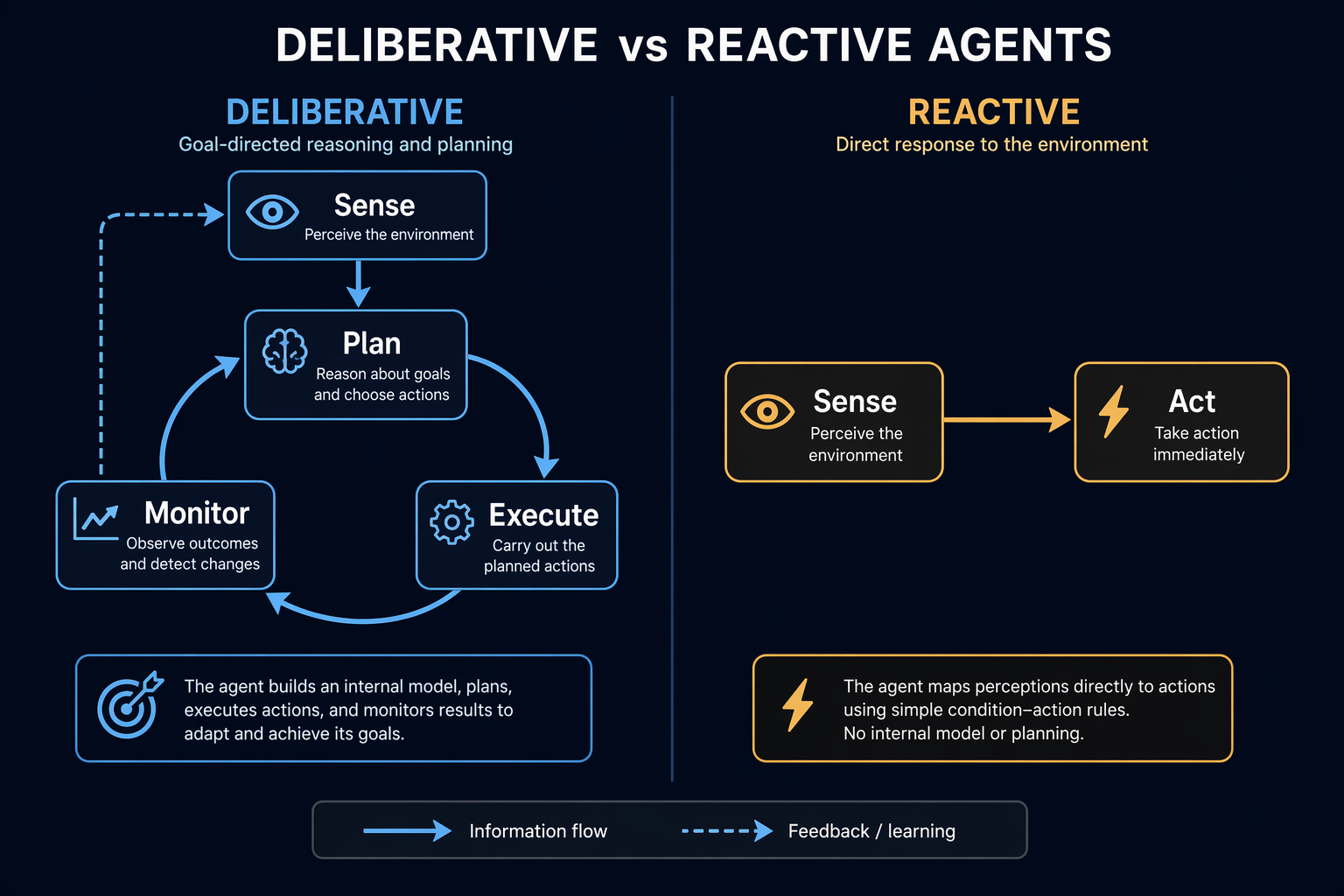
The Deliberative Approach
Deliberative agents operate with a 'think then act' strategy. They build a model of the world and then plan their actions based on that model.
This approach allows for complex decision-making, but it can be slow. The time spent planning can be a disadvantage in fast-changing environments.
Intelligence is not about thinking; it's about doing the right thing at the right time.
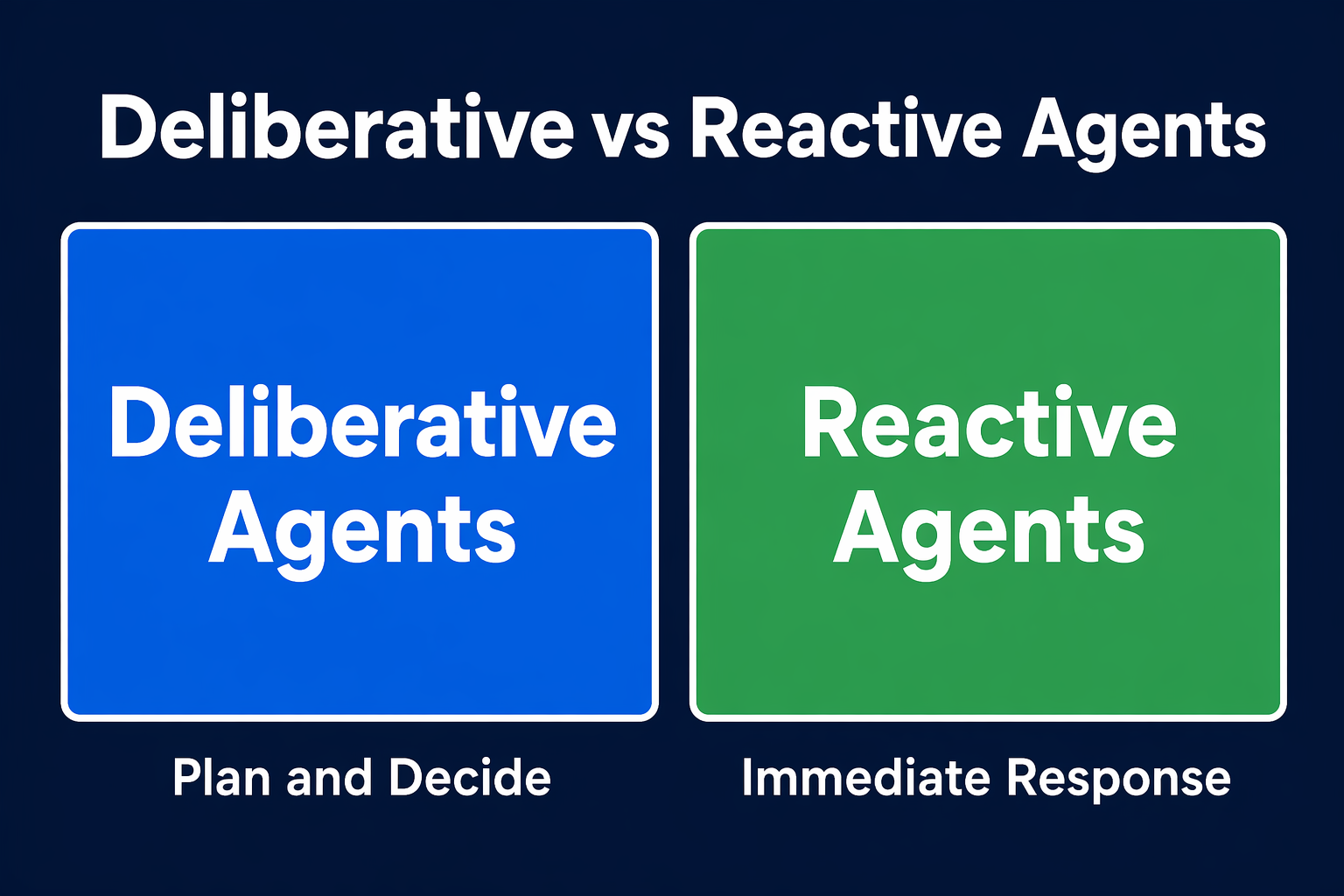
This visual illustrates how Deliberative vs. Reactive Agents applies in real-world Advanced Agentic AI scenarios.
See the difference between planning and reacting. This comparison illustrates the core architectural choices.
Agent Architectures Visualised
A visual overview of deliberative and reactive agents.
Which agent type is better suited for a real-time, unpredictable environment?
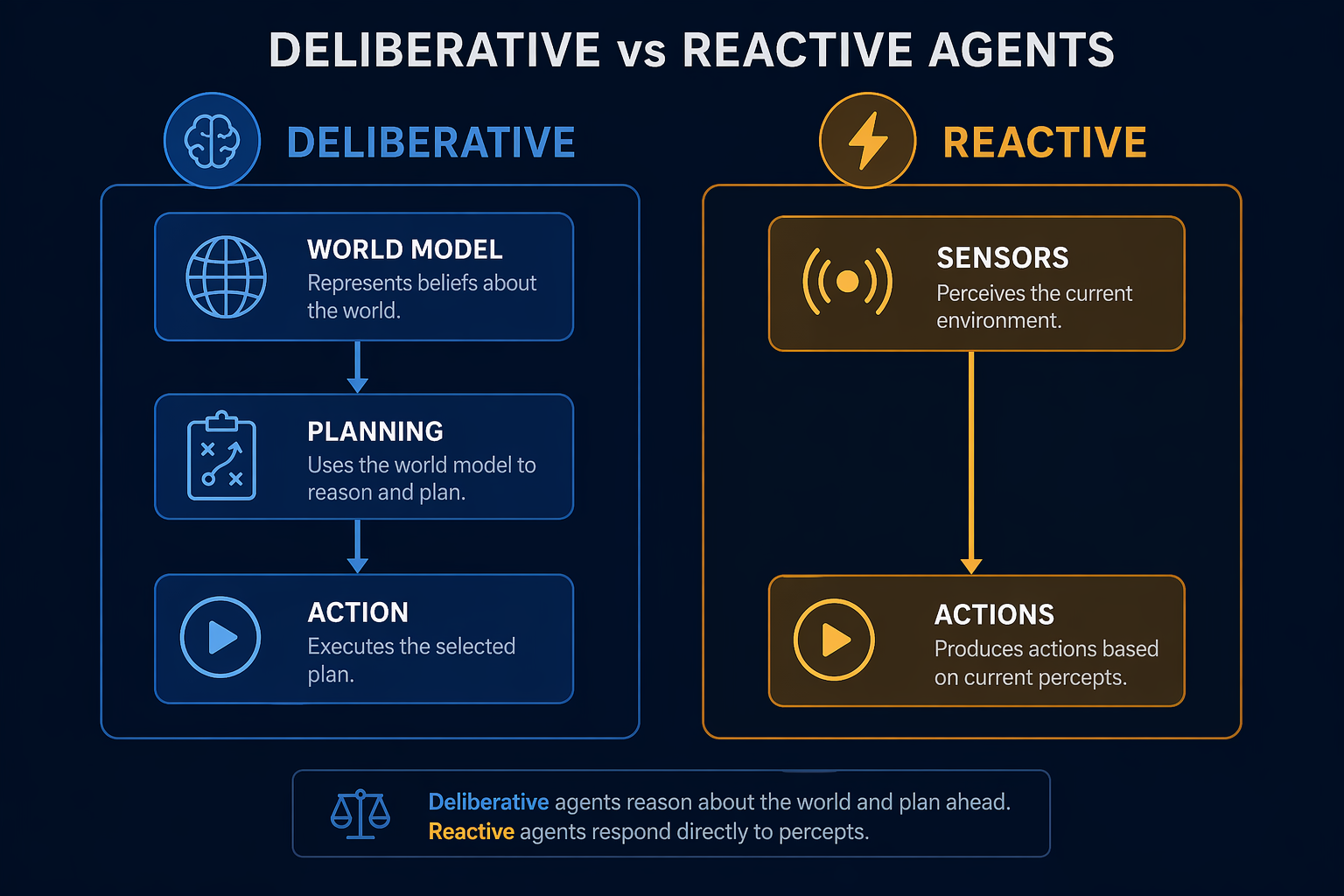
Visualising Agent Types
The Reactive Approach
Reactive agents operate on a 'sense then act' principle. They respond directly to their immediate environment without any planning.
This makes them fast and efficient, but it also means they can struggle with complex tasks requiring foresight.
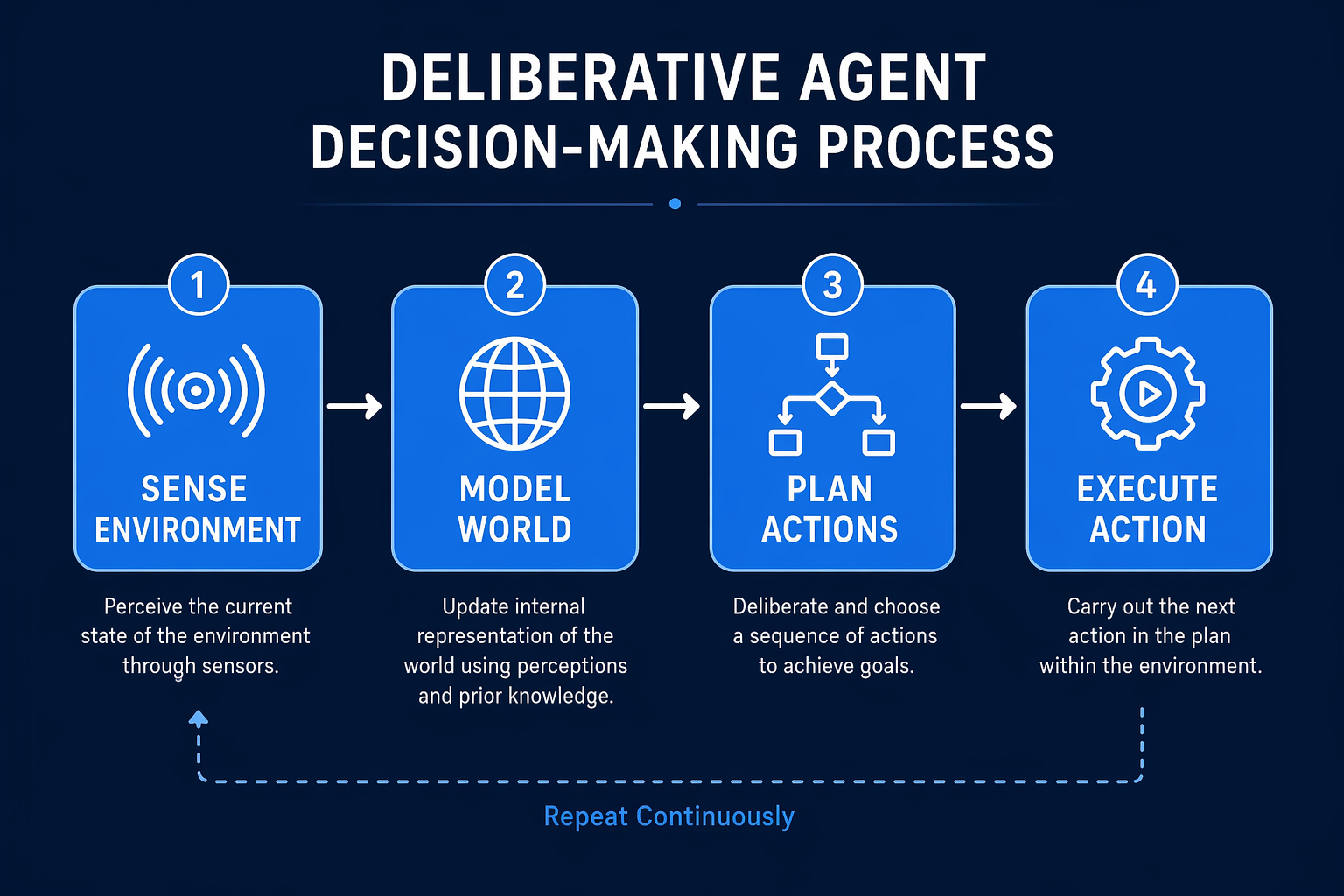
The planning phase in deliberative agents relies on having a complete model of the environment. Without this model, the agent cannot effectively predict the consequences of its actions.
Contrasting Agent Responses
This comparison shows how deliberative agents plan before reacting, whereas reactive agents respond immediately. The outcome for deliberative agents is a planned outcome, while reactive agents provide an immediate response.
Deliberative agents require a complex world model. This model can be difficult to create and maintain in dynamic environments.
Reactive agents respond quickly to changes. This speed is essential for real-time control systems.
Deliberative agents are suitable for complex tasks. Reactive agents excel in simple, repetitive tasks.
See agents in action in self-driving cars and robotic vacuum cleaners. This demonstrates the practical applications of both agent types.
Real-World Agent Applications
Examples of deliberative and reactive agents in action.
Choosing the Right Agent
The choice between deliberative and reactive agents depends on the application. Consider the environment's complexity and the required response time.
Deliberative agents are better for complex, strategic tasks. Reactive agents are ideal for simple, real-time tasks.
If you remember only three things…
Deliberative Agents
Plan before acting, using a world model. They are suited for complex tasks but can be slow.
Reactive Agents
Act based on immediate sensory input. They are fast and efficient for real-time control.
Environment Matters
The choice depends on the environment's complexity. Consider response time and task requirements.
Trade-offs Exist
Deliberation offers strategic depth at the cost of speed. Reaction prioritises speed at the expense of planning.
Test Your Understanding
Prompt a Deliberative Agent to Plan
Write a prompt for an AI agent that encourages deliberative planning to solve the following problem.
Imagine you're developing an AI delivery robot. Its task is to deliver a fragile package from Warehouse A to Office B across a busy urban environment. The environment includes unpredictable pedestrian traffic, temporary road closures, and varying delivery windows. A purely reactive approach might get stuck or be inefficient. Your prompt should instruct the robot's deliberative planning module to consider multiple factors before deciding on a route.
Term Glossary
4 verified conceptsFrom Reaction to Prediction
You now understand the fundamental difference between deliberative and reactive agents and when to apply each approach.
This is where intelligent systems stop reacting – and start anticipating.
Next, we'll look at the architecture of hybrid agents.
Audio lesson recap
A concise audio summary of this lesson — great for reinforcing key concepts on the go.
Hear it discussed
About three minutes on the ideas in this lesson
Sterling
AI tutor
Vivienne
Sceptical challenger
Press play to start the discussion…
Full transcript · click any line to jump
Choose agent architecture based on task
Select deliberative agents for complex, strategic tasks requiring foresight and planning. Opt for reactive agents when speed and immediate response are paramount in dynamic environments.
Understand the speed-strategy trade-off
Deliberative agents offer strategic depth through planning but are slower due to processing time. Reactive agents provide rapid responses but lack the capacity for complex, long-term strategy.
Environment dictates agent suitability
A complex, unpredictable environment favours reactive agents for quick adaptation. Stable environments with clear goals benefit from deliberative agents' planned, reasoned actions.
Ask anything about Deliberative vs. Reactive Agents. Sterling will answer — concisely, and with his customary level of patience.