From Automation to Generation
Understand the fundamental shift that turns a rule-following machine into a creative system.

Automation follows a path you built. Generation builds a path you didn't.
scenario
A vending machine gives you exactly what you selected. What kind of machine could give you a drink that doesn't yet exist?
What is the core limitation of traditional, programmatic automation?
Two Different Engines
["Traditional automation is an execution engine. You provide a complete set of instructions—the 'if this, then that' rules.","The system's only job is to follow those instructions flawlessly and repeatedly."]
["Generative AI is a synthesis engine. You provide a prompt, a seed, or a goal.","The system's job is to explore a vast space of possibilities and construct a novel output that meets your criteria."]
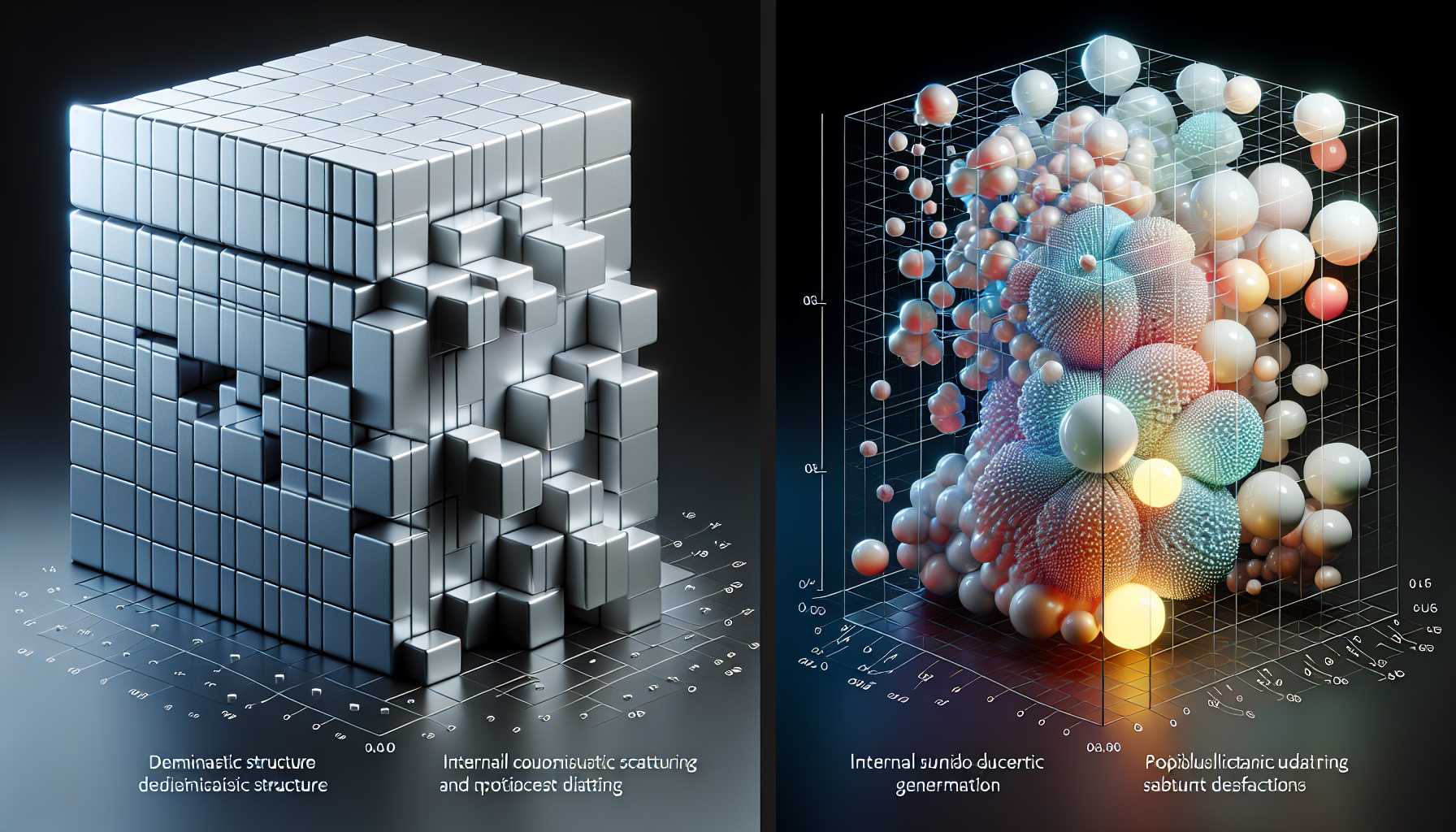
Deterministic Grid vs Probabilistic Cluster
The Cause-Effect Chain of Each Approach
The diagram reveals the causal chain. Automation is a closed loop of certainty, from rule to result. Generation is an open funnel of probability, where the same input can lead to many valid outputs. The shift is in the nature of the 'processing' step.
This is the moment the penny drops. You're not just learning two definitions. You're seeing the fault line between the old digital world and the new one. Every 'AI' news headline, every product demo—you can now place it on one side of this line or the other. That is a superpower.
The Scenario
A company uses software to handle common customer queries. The volume is high, but the questions are repetitive.
The Challenge
They need to answer thousands of tickets accurately without hiring an army of support staff. The answers are known, but delivering them at scale is the problem.
The Resolution
Traditional automation works perfectly. A rules-based chatbot or ticket-routing system executes pre-written responses efficiently. This is automation.

This image reveals that automation and generation are not just software ideas—they have different physical footprints and visual signatures. The synchronous blink of server lights embodies deterministic execution, while the flowing nebula on screen embodies probabilistic synthesis. The contrast is in the very nature of the activity each hardware supports.
Its greatest strength is perfect reliability. Its inherent limit is it cannot handle the unknown.
Its greatest strength is novelty and adaptation. Its inherent cost is unpredictability—you guide it, but don't control every pixel.
A generative AI model (creation) is run by automated infrastructure (execution). The magic is in knowing which part is doing what.
You will see a single trigger cause two profoundly different effects: perfect replication versus unique synthesis.This matters because it grounds the abstract lesson in a visceral, visual metaphor for the two modes of operation.
The Synthesis Engine
Watch the shift from fixed execution to fluid creation.
Why This Distinction is Your First Tool
["This contrast is not academic. It is your primary lens for assessing any AI claim.","When someone says 'AI-powered', you can now ask: is it automating a known task, or generating a new solution?"]
["That question separates marketing hype from tangible capability.","It tells you where the value truly lies—in efficiency gains or in creative expansion."]
Test Your Understanding
If you remember only three things…
Automation Executes
It follows pre-written rules with perfect reliability. It solves known problems at scale.
Generation Synthesises
It uses learned patterns to create novel outputs. It explores possibilities for open-ended problems.
The Line is the Logic
The shift is from deterministic 'if-then' logic to probabilistic 'what-if' exploration. This changes what's possible.
Your New Lens
Use this contrast to explain AI claims. Ask: is it following a map, or drawing a new one?
Generate Creative Social Media Captions
Write a prompt that instructs a generative AI to create engaging social media captions for the new eco-friendly smart water bottle campaign, emphasizing creativity and diverse approaches.
Your company is launching a new line of eco-friendly, smart water bottles. The marketing team needs a series of fresh, engaging social media captions for Instagram that highlight both the sustainability and smart features. Instead of simply listing facts, they want captions that evoke a sense of future, innovation, and environmental responsibility, appealing to a tech-savvy, conscious audience. They specifically asked for *creative, diverse ideas* for 5 distinct posts, avoiding repetition.
Term Glossary
4 verified conceptsSeeing the Fault Line
You now have the fundamental lens for understanding modern AI. You can distinguish between systems that optimise the known and those that invent the new. This isn't just a definition—it's a diagnostic tool you can apply to any technology claim, allowing you to separate genuine innovation from rebranded automation.
This is the shift from software that processes your instructions to software that partners in your intent—a shift that redefines what machines can do.
Next, we'll see how generative systems learn the patterns they use—not from rules, but from data.
Audio lesson recap
A concise audio summary of this lesson — great for reinforcing key concepts on the go.
Hear it discussed
About three minutes on the ideas in this lesson
Sterling
AI tutor
Vivienne
Sceptical challenger
Press play to start the discussion…
Full transcript · click any line to jump
Automation executes, Generation synthesises new paths
Traditional automation follows pre-defined instructions flawlessly, excelling at repetitive tasks within known parameters. Generative AI explores possibilities to construct novel outputs, even when the exact path isn't mapped beforehand.
Shift from certainty to probability
Automation operates within a closed loop of certainty, guaranteeing predictable results from fixed rules. Generation embraces an open funnel of probability, allowing for varied, novel, and sometimes unpredictable outputs from the same input.
Assess AI claims with this lens
Understanding this distinction is crucial for evaluating any AI application, determining if it's a sophisticated tool or a creative partner. Most real-world systems blend both, so identifying which part does what is key to effective use.
Ask anything about From Automation to Generation. Sterling will answer — concisely, and with his customary level of patience.