What Makes AI Generative?
Discover the architectural shift that transformed AI from a system that follows rules into one that creates from patterns.

Generative AI doesn't follow a map. It draws a new one from the terrain it has seen.
Consider this
The most sophisticated chess engine in the world cannot compose a sonnet. The most eloquent language model cannot calculate a winning move. Why is one form of intelligence so blind to the other's domain?
You will see a literal visualisation of data shifting from a rule-based processing system to a pattern-learning, generative one. This matters because it grounds the abstract architectural shift in a concrete, observable transformation.
The Shift to Generation
Watch the architecture transform.
What is the fundamental difference that makes an AI 'generative'?
The Pattern-Completion Engine
Traditional AI systems are discriminative. They are excellent at sorting, filtering, and choosing between existing options. You give them an input, and they select the most probable output from a known set.
Generative systems invert this logic. They learn a compressed representation of the data's underlying structure—its statistical terrain. When prompted, they don't choose; they complete the pattern by sampling from this learned model, often creating something that didn't exist in the original data.
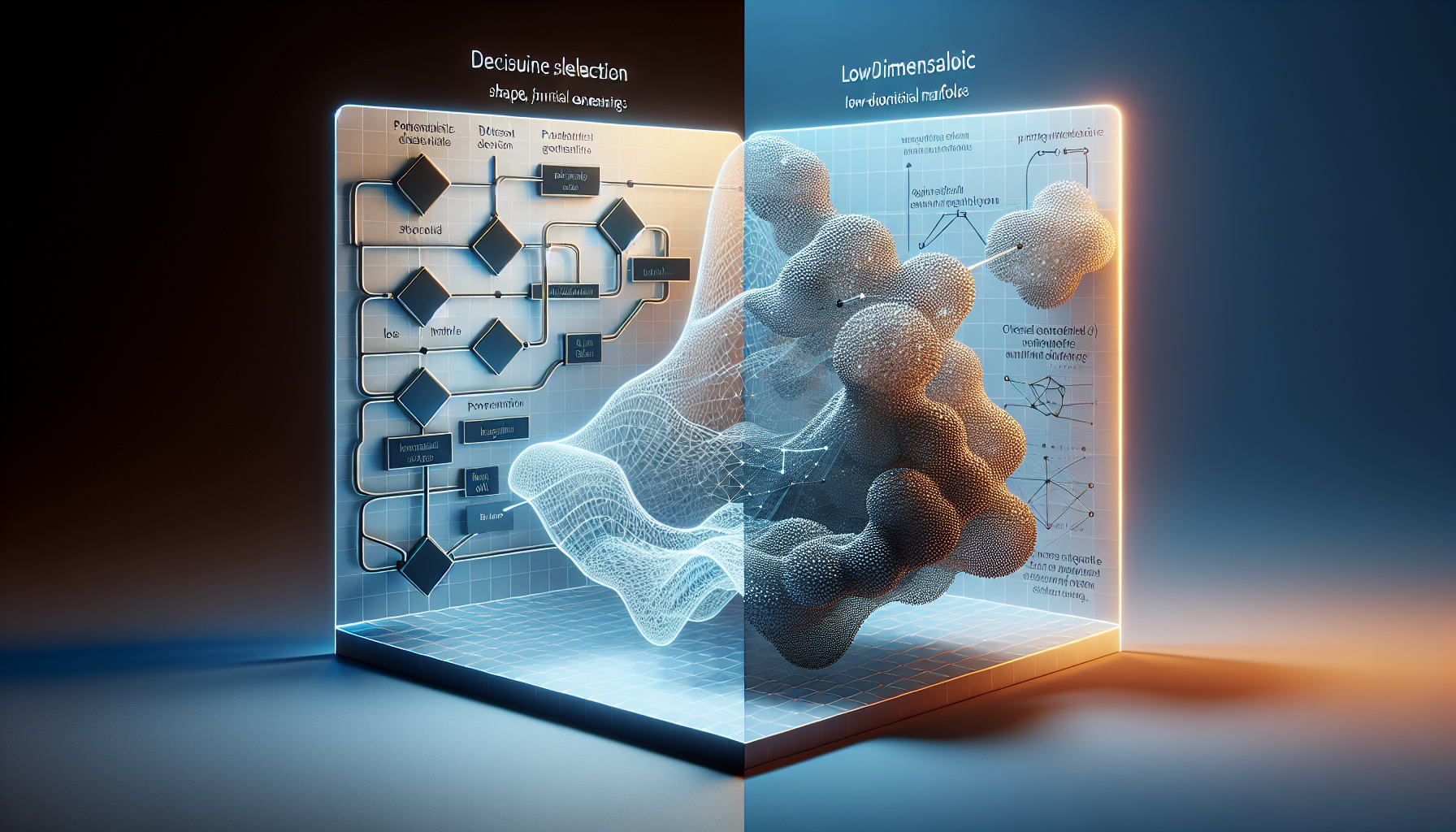
From Rule-Based Selection to Pattern-Based Generation
The Cause-Effect Chain of Generation
This chain reveals that the pivotal difference occurs at the 'Core Objective'. A discriminative model's path narrows toward a single answer. A generative model's path expands into a space of possibilities, then samples from it. The addition of the 'Sample' step is the moment of creation.
The Signature of Creation
Remember this: if you can point to the exact rule or line of training data that produced an AI's output, it is not generative. True generative output has a degree of novelty—it is an interpolation or extrapolation within the model's learned space of possibilities. This signature of novelty, not perfection, is what you're looking for.
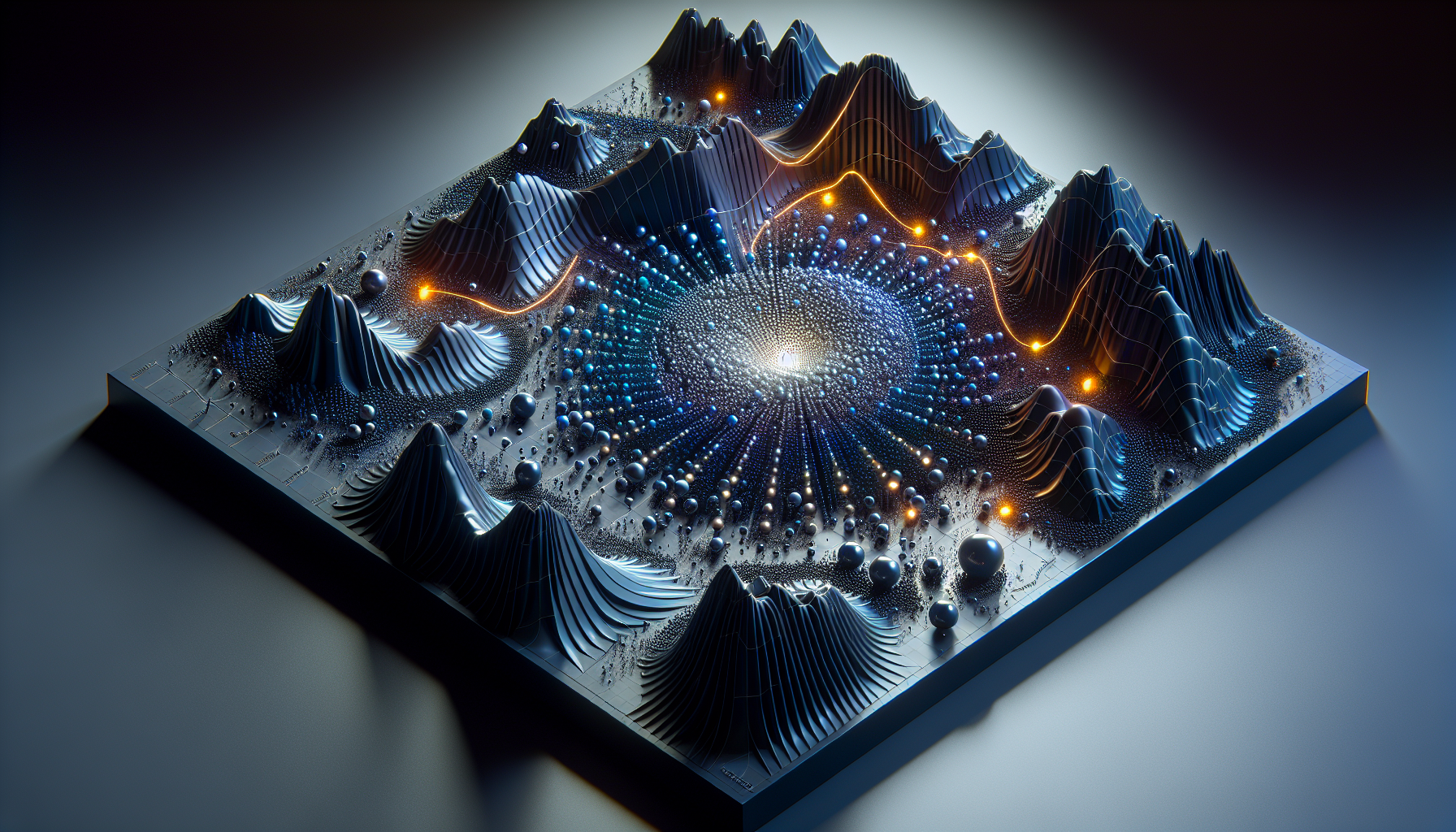
This image interprets the generative act not as random invention, but as a guided fall across a learned statistical field. The model's output is a point that settles into a high-probability region, making it feel 'right' even though it's new.
Generative models think in likelihoods. They ask 'What is statistically probable given what I've seen?', not 'What is logically correct given the rules?'
The training process distills vast datasets into a compact model of relationships. Generation is the decompression of that model into new instances.
When a generative model 'hallucinates', it's not broken—it's sampling from the edges of its probability model. This same mechanism produces creative variation.
The Scenario
Pharmaceutical researchers need novel molecular structures that can bind to a disease target. The space of possible molecules is astronomically large.
The Challenge
Traditional methods rely on simulating known molecular families or manual design, which is slow and explores a tiny fraction of the possibility space.
The Resolution
A generative AI model is trained on databases of known molecules and their properties. It learns the 'rules' of chemical stability and binding. Researchers can then prompt it to generate entirely new molecular structures that are probable and meet their criteria.
You will see the moment of generation as a physical process—a point finding its place in a learned world. This matters because it explain 'creation' as a guided statistical process, not magic.
The Act of Creation
Watch a new point be generated.
Pause and reflect
Before the quiz, pause. Can you articulate the difference to yourself without using jargon?
Test Your Understanding
Generative AI creates by completing patterns it has learned, not by executing instructions it was given.
This pattern-completion mechanism is the single shift that explains its versatility across text, image, and code.
If you remember only three things…
The Architectural Divide
Discriminative AI chooses from options. Generative AI creates from a model of possibilities. This is a fundamental design difference, not just a scale difference.
Pattern Over Rules
The core mechanism is learning the statistical shape of data—its distribution—and then sampling new points from that shape. Logic is replaced by probability.
Novelty as Signature
If you can trace an output directly to a training example or a rule, it isn't generative. True generation involves interpolation or extrapolation within the learned space.
Error and Creativity
The same probabilistic mechanism that produces useful novelty can also produce plausible but incorrect 'hallucinations'. This isn't a bug in the traditional sense.
Term Glossary
4 verified conceptsCraft a Prompt for Creative Storytelling
Your goal is to get a generative AI to create a unique story. Write a prompt that guides the AI to produce a narrative, rather than just factual information or a summary.
You want a generative AI to create a *brand new, imaginative short story*. Your first attempt is the prompt: 'Write about a knight.' This results in an output that lists facts about medieval knights or summarizes a well-known legend, rather than inventing a unique plot or characters. The AI is acting more like a search engine or summarizer. Your task is to craft a prompt that truly encourages the AI's creative engine.
The New Terrain
You began with two forms of intelligence that seemed mutually exclusive. Now you see they are two different designs on the same continuum: one for selection, one for creation.
The terrain of data is no longer just something to be measured and categorised. It is a material to be learned and reshaped. This changes what we ask of our systems.
The chess engine and the poet remain separate, but the architecture that could one day unite them is no longer a mystery. You have seen its plan.
From Selection to Creation
You now see the architectural line that separates AI that automates choices from AI that augments possibility. This is the foundation for everything that follows.
The system is no longer looking up answers; it is drawing a new map from the terrain.
Next, we'll see how this pattern-completion engine is built, starting with the fundamental unit of modern AI: the neural network.
Audio lesson recap
A concise audio summary of this lesson — great for reinforcing key concepts on the go.
Hear it discussed
About three minutes on the ideas in this lesson
Sterling
AI tutor
Vivienne
Sceptical challenger
Press play to start the discussion…
Full transcript · click any line to jump
Generative AI creates novel outputs
Understand that generative AI moves beyond automation by creating entirely new solutions, rather than just performing known tasks faster. This capability allows for augmentation, opening doors to previously unprogrammed possibilities and innovation.
Probability, not logic, drives generation
Grasp that generative AI operates on learned probability models, not rigid rules or decision trees. This fundamental shift from logic to likelihood enables it to generate diverse outputs like text, images, and code from a single core mechanism.
Errors reveal model's creative edges
Recognise that 'hallucinations' in generative AI aren't bugs but 'improbable' pattern completions, sampling from the model's statistical boundaries. This same mechanism is responsible for its creative variations and novel outputs.
Ask anything about What Makes AI Generative?. Sterling will answer — concisely, and with his customary level of patience.