Biological Sequence Watermarking
Learn how mathematical markers distinguish synthetic biological sequences from natural proteins to ensure safety.
In the future of synthetic biology, the ability to trace the origin of every sequence will be the primary defense against bio-risk. You are learning the very architecture that will define this security standard for years to come. By mastering this, you step into a role where you actively shape the safety of the next generation of biological discovery, transforming from a passive observer into a guardian of synthetic integrity.
Identify Provenance Markers
Examine the following sequences and classify them based on their statistical characteristics.
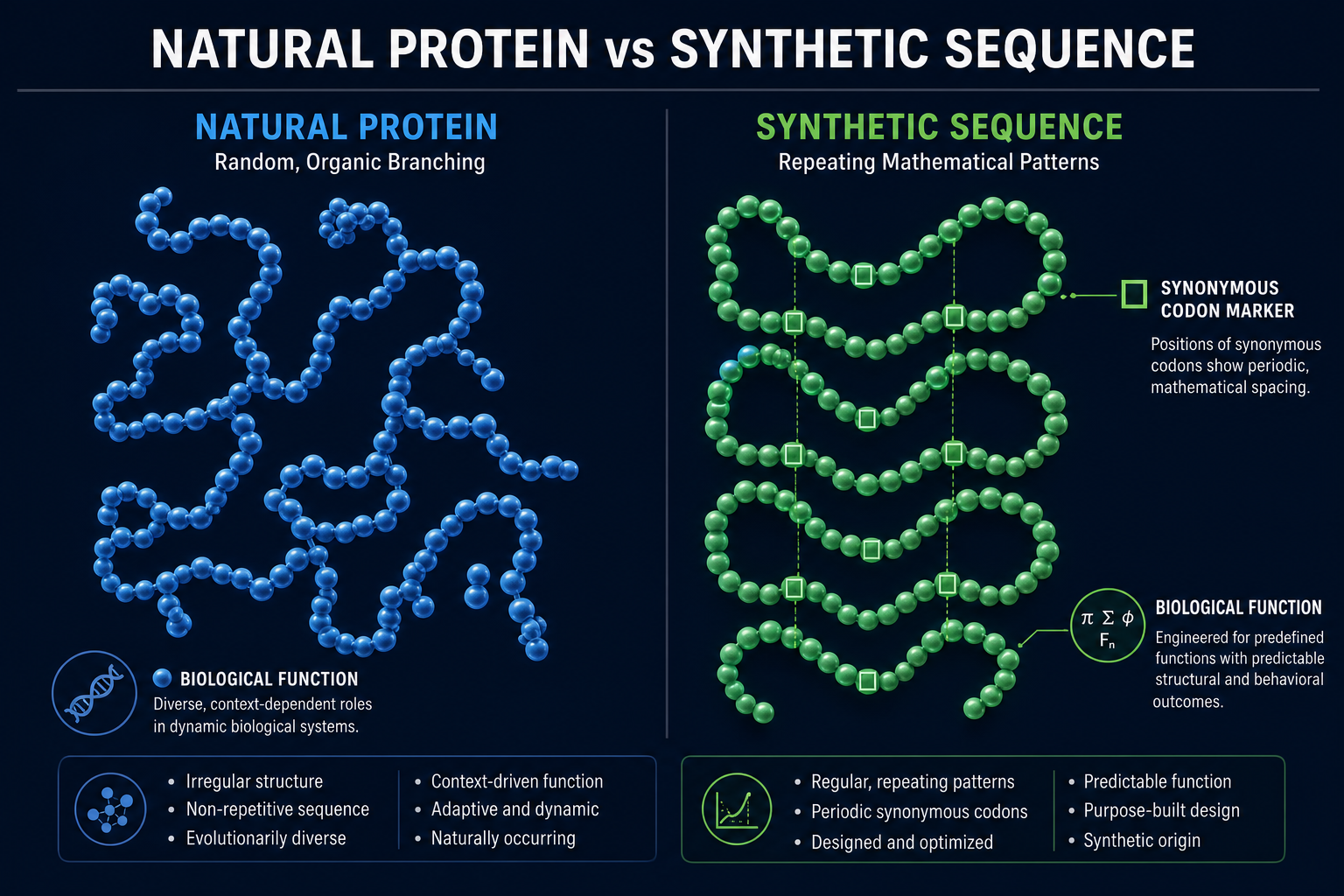
Sequence A: High codon randomness, consistent with natural protein synthesis. Sequence B: Subtle, repetitive statistical deviations in synonymous codon usage, indicating a likely synthetic origin.
Before we begin
How can we prove a protein sequence was generated by an AI rather than evolved in nature? The answer lies in embedding a mathematical fingerprint into the sequence that remains invisible to biological function but clear to detection software.
What is the primary requirement for a biological watermark to be effective against tampering?
The Mechanism of Biological Watermarking
Watermarking biological sequences involves embedding a specific, non-functional mathematical signal into the protein's primary structure. By carefully adjusting the amino acid choices that do not alter the protein's fold or activity, we create a detectable pattern.
The system functions by identifying synonymous codons—different genetic codes that produce the same result—and using them to encode a watermark. This creates a signature that is statistically distinct from the random noise found in natural protein sequences.
Imagine a protein sequence as a series of instructions; we are essentially inserting a subtle, unique 'watermark' into the syntax without changing the final product's meaning. The sequence remains functionally identical to the original, yet carries a verifiable origin stamp.
This approach ensures that even if a synthetic sequence is modified, the underlying statistical marker often remains detectable. By maintaining this provenance, we can track the output of generative models and identify sequences that warrant further safety review.
The viewer sees a digital sequence being scanned for hidden markers. This demonstrates how mathematical provenance is verified in a professional research environment.
Analyzing Sequence Provenance
A researcher verifies the origin of a synthetic protein sequence.
Before/After Sequence Integrity
The contrast highlights that natural sequences lack the deliberate statistical bias introduced by watermarking. This gap is what allows detection systems to correctly classify the source of any sequence.
Confidence check
How confident do you feel about why natural sequences are easier to distinguish from synthetic ones?
If a watermark changes the protein's behavior, it becomes a target for removal or mutation by malicious actors.
Watermarks don't need to be unique IDs; they just need to be statistically improbable in natural biological data.
A reliable system works across different AI models, avoiding the need for bespoke markers for every new system.
Test Your Understanding
If you remember only three things…
Provenance
Watermarking provides a clear way to distinguish between natural sequences and AI-generated products.
Imperceptibility
Effective markers must be invisible to biological function to prevent them from being identified and removed.
Statistical Signatures
Markers work by creating statistically distinct patterns in codon usage that deviate from natural randomness.
Robustness
The system must remain detectable even if the sequence undergoes minor modifications or transformations.
Term Glossary
4 verified conceptsFrom Unmarked to Verified
You now understand how mathematical signals allow us to track the origin of synthetic biological sequences. This shift moves us from a reactive stance to one where provenance is baked into the very structure of the data.
This is where synthetic biology stops being a black box and starts becoming a traceable, secure field of study.
Explore the technical implementation of SynthID in digital media to see how these principles scale across modalities.
Audio lesson recap
A concise audio summary of this lesson — great for reinforcing key concepts on the go.
Hear it discussed
About three minutes on the ideas in this lesson
Sterling
AI tutor
Vivienne
Sceptical challenger
Press play to start the discussion…
Full transcript · click any line to jump
Ask anything about Biological Sequence Watermarking. Sterling will answer — concisely, and with his customary level of patience.